This article is for educational purposes only and is not legal, tax, or financial advice. Debt collection rules vary by state. Read our Disclaimer.
Last reviewed: November 10, 2026. Sources are listed at the end.
Americans now owe $1.29 trillion on credit cards. That’s a record.
If you’re looking at a statement you can’t cover, the question is simple: what happens if I just stop?
You won’t go to jail. Your Social Security check isn’t fair game for a card company. But the road from “missed payment” to “court summons” is real, and knowing each step gives you more options than panic does.
Key takeaway
Stopping payments sets off a fairly predictable chain: late fees and credit damage first, a charge-off around six months, then collectors and sometimes a lawsuit. A card company can garnish wages or freeze a bank account only after it wins a court judgment, and federal law shields Social Security from private creditors. Calling your issuer or a nonprofit credit counselor early usually beats waiting.
Key numbers
| Item | Figure |
|---|---|
| U.S. credit card balances, Q3 2026 | $1.29 trillion (record) |
| Average interest rate, accounts charged interest (Aug 2026) | 22.36% |
| Card balances moving into serious delinquency (90+ days), Q3 2026, annualized | 6.87% |
| Bank charge-off rate on card loans, Q2 2026 | 3.82% (peak: 10.54% in Q4 2009) |
| Typical point when a bank charges off an unpaid card | About 180 days past due |
| How long a late payment can stay on your credit report | 7 years |
| Max wage garnishment for ordinary consumer debt (federal) | 25% of disposable pay, or less |
| Social Security protected in a bank account when a creditor garnishes | 2 months of directly deposited benefits |
Sources: New York Fed Household Debt and Credit Report (Nov 10, 2026); Federal Reserve G.19 and charge-off data via FRED; FFIEC; Fair Credit Reporting Act; U.S. Department of Labor; CFPB.

First, the real cost of carrying a balance
Before anything goes wrong, interest is already working against you. The Federal Reserve’s latest figure for accounts that are charged interest is 22.36%, so an $8,000 balance costs about $149 a month in interest alone ($8,000 × 22.36% ÷ 12).
That’s why minimum payments feel like a treadmill.
The timeline if you stop paying
Here’s the usual order of events:
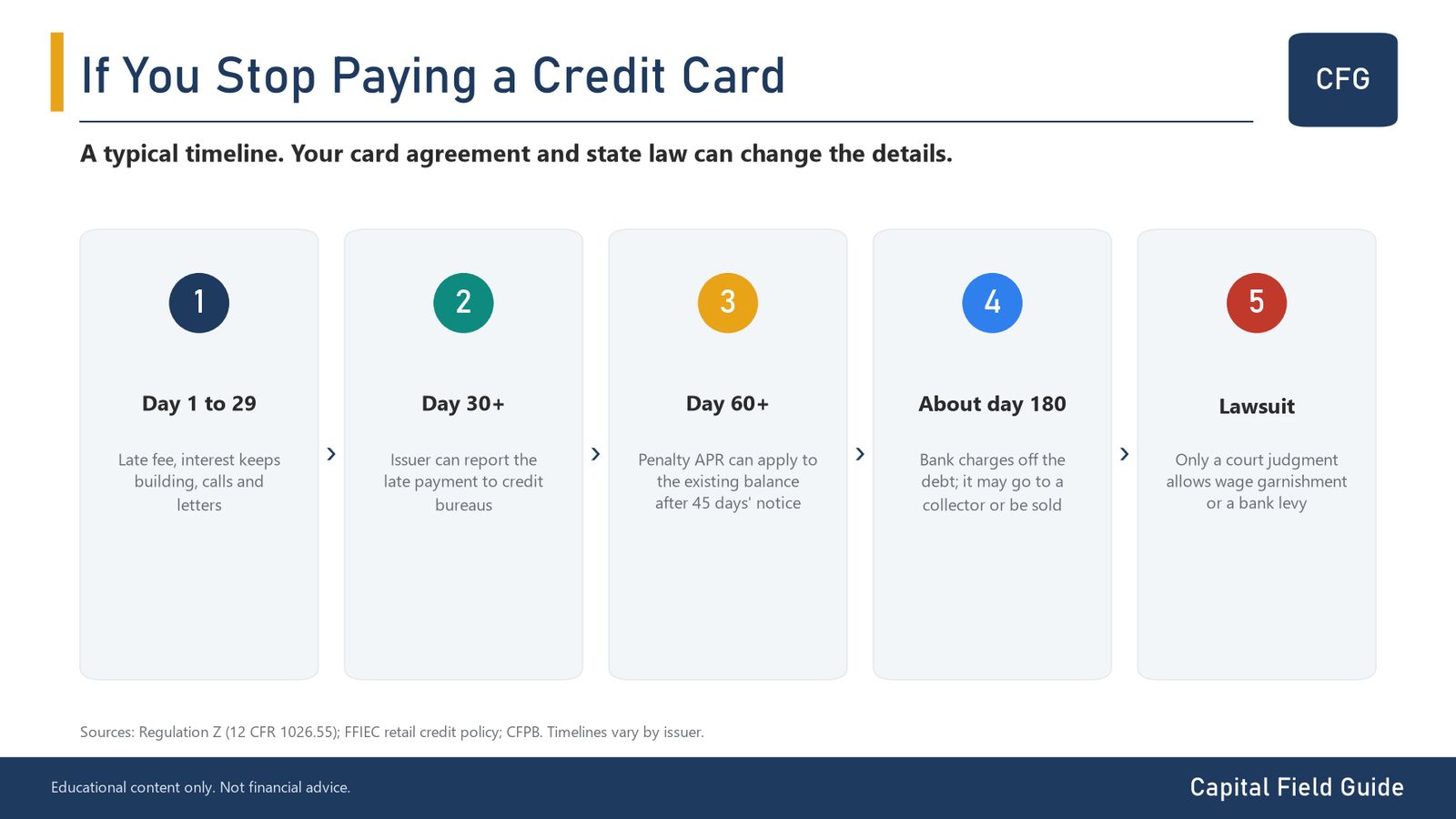
Days 1 to 29. You’ll owe a late fee, interest keeps compounding, and the calls and letters start. A payment that’s a few days late usually isn’t reported to the credit bureaus yet.
30 days and beyond. The issuer can report the late payment. This is where your credit score takes the first real hit, and each later month (60, 90, 120 days) can be reported too.
60 days late. Once you’re more than 60 days behind, federal rules let an issuer move your existing balance to a penalty APR, but only after 45 days’ written notice. If you then make six straight on-time minimum payments, the issuer has to drop the penalty rate on that existing balance.
Around day 180. Banks generally charge off credit card debt at 180 days past due, under federal banking guidance. A charge-off is an accounting move. You still owe the money. The bank may hand the account to a collection agency or sell it to a debt buyer.
A lawsuit. A creditor or debt buyer can sue. If you don’t respond, it can win by default. Only after a court judgment can it garnish wages or levy a bank account in most cases.
Is this happening more right now?
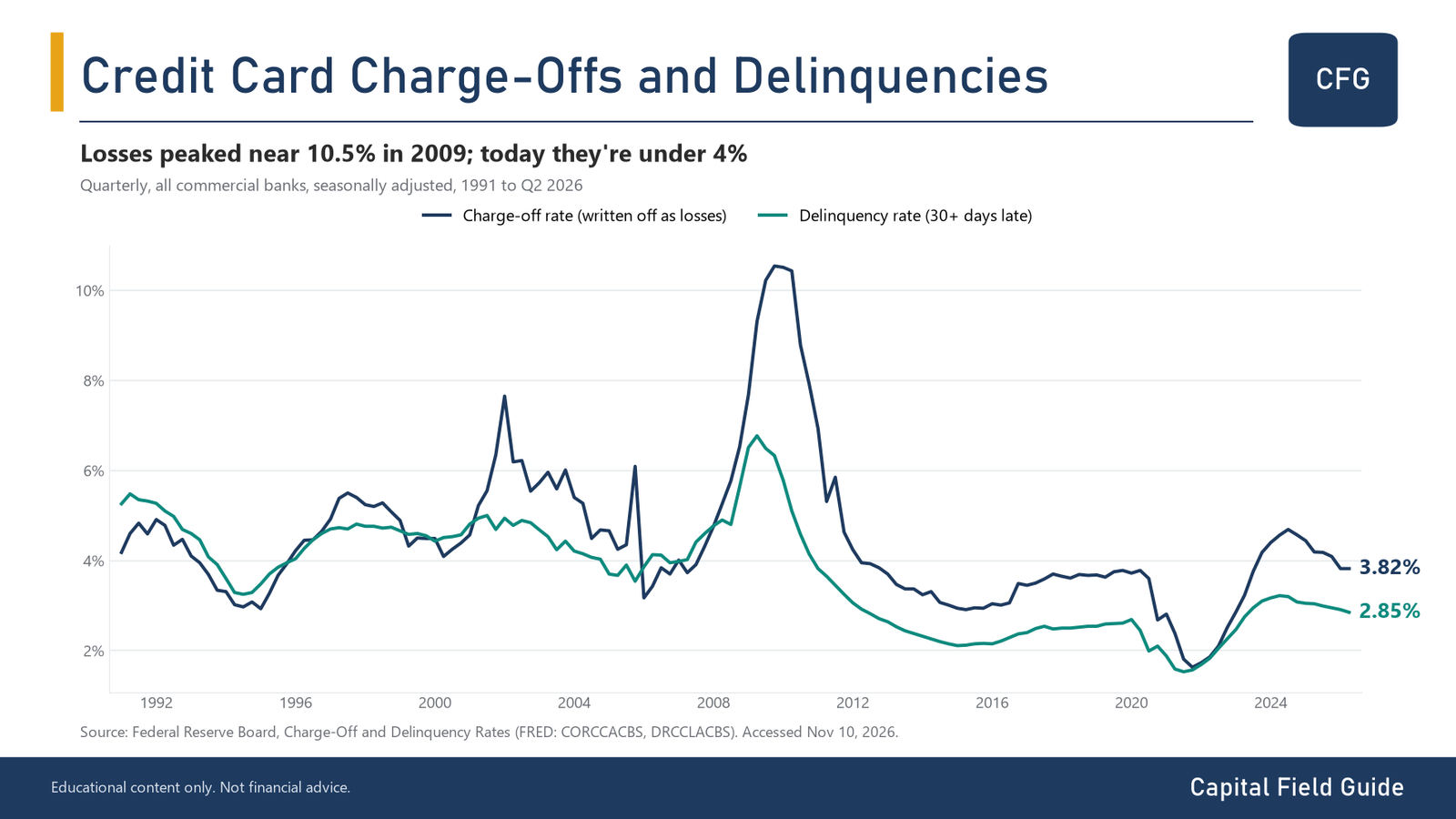
Losses are up from the 2021 lows, when stimulus money helped people pay down cards, but nowhere near the 2009 peak. The New York Fed’s newest report even shows the flow into serious delinquency dipping slightly from a year earlier. Balances are high. Widespread defaults aren’t happening.

What a card company can’t take
This is the part retirees most need to hear.
Your Social Security. Federal law (42 U.S.C. 407) protects Social Security benefits from private creditors like card companies and debt buyers. The government can take part of benefits for some debts it’s owed, such as federal taxes, and for child support or alimony. A credit card isn’t one of them.
Two months of benefits in the bank. If a creditor with a judgment garnishes your bank account, the bank must check for federal benefits directly deposited in the prior two months and leave that amount alone.
Get $2,000 a month by direct deposit and up to $4,000 in the account is protected. Paper checks you deposit yourself don’t get this automatic review.
Most of your paycheck. For ordinary consumer debt, federal law caps garnishment at 25% of disposable earnings or the amount above 30 times the federal minimum wage ($217.50 a week), whichever is less. Some states protect more.
You. There’s no debtors’ prison for credit card debt. Ignoring a court order is a different matter, so never ignore a summons.
Watch out
Retirement accounts get strong protection in bankruptcy, and many states protect them from judgment creditors too. But money you’ve already withdrawn and parked in a regular checking account can lose that protection. If you’re being sued, check your state’s exemptions before moving money around.
Two traps people walk into
Old debt that comes back to life. Every state sets a statute of limitations for suing on a debt, most often three to six years, according to the CFPB. After that, a collector generally can’t sue.
But in many states, a small “good faith” payment or a written acknowledgment can restart the clock. Before paying anything on an old account, find out how old it is.
The tax bill on forgiven debt. If a creditor forgives or settles $600 or more, you’ll usually get a Form 1099-C, and the IRS generally treats the canceled amount as income. You may be able to exclude it if you were insolvent (debts larger than assets) at the time, using Form 982.
Settling $10,000 of debt for $4,000 could add $6,000 to your taxable income.
History check: why the rules look like this
Most of today’s protections were written after bad experiences.
The Fair Debt Collection Practices Act of 1977 banned harassment and abusive tactics by third-party collectors. The CARD Act of 2009, passed in the middle of the financial crisis, restricted surprise rate hikes on existing balances and created the 60-day penalty APR rule. And the 2011 Treasury rule on federal benefits stopped banks from freezing entire accounts holding directly deposited Social Security money.
Our read: what we’d watch
Our read
This is our opinion, not a forecast.
If unemployment stays low, history suggests today’s high balances can stay manageable, as they did in 1997 and 1998, when card charge-offs topped 5% without a broader crisis. If job losses pick up, card defaults tend to jump fast, as they did in 2008 and 2009.
Jobs aren’t the only trigger, though. Charge-offs nearly tripled from late 2021 to 2024 while unemployment stayed near 4%. So we’d watch the monthly jobs report and the delinquency rate together, not the headline debt total.
The other number we’d watch is the interest rate. Card rates track the Fed’s policy rate loosely, and they’re still above 20%. A rate that high makes “I’ll pay it down slowly” a much more expensive plan than it was a decade ago, when the average was about 13.5%.
The counterargument deserves a hearing: a record dollar total partly reflects inflation and a bigger economy, and the newest delinquency flow numbers improved slightly. We agree the sky isn’t falling. Our concern is narrower. For anyone carrying a balance at 22%, the math works against them every single month.
What you can do this week
Practical steps
1. Call the issuer before you miss a payment. Many card companies have hardship programs that can lower the rate or payment for a while. They’re more flexible before an account goes delinquent than after.
2. Talk to a nonprofit credit counselor. Agencies affiliated with the National Foundation for Credit Counseling offer low-cost or free counseling and debt management plans. Be wary of for-profit “debt settlement” firms that ask you to stop paying and charge large fees.
3. Make sure Social Security arrives by direct deposit. That’s what triggers the automatic two-month protection if a creditor ever garnishes your account.
4. Pull your free credit reports at AnnualCreditReport.com to see what’s actually being reported and when each debt went delinquent.
5. If you get a court summons, respond. Some people in this situation contact legal aid or a consumer attorney. Showing up, even to raise a statute of limitations defense, can change the outcome.
FAQ
Can I go to jail for not paying a credit card?
No. Unpaid credit card debt is a civil matter. You can face a lawsuit, but not arrest for the debt itself. Ignoring a judge’s order is a separate issue.
Can a credit card company take my Social Security?
Not for credit card debt. Federal law protects Social Security from private creditors, and banks must protect two months of directly deposited benefits when an account is garnished.
Does a charge-off mean the debt is gone?
No. It means the bank wrote it off as a loss on its books. You still owe it, and it can be collected or sold.
What happens to credit card debt when someone dies?
It’s generally paid from the estate. Family members usually aren’t responsible unless they co-signed, were joint account holders, or live in a community property state with rules that apply. Authorized users aren’t on the hook.
The bottom line
Stopping payments doesn’t make credit card debt disappear. It turns a monthly bill into a timeline that ends, for some people, in court.
But the outcomes people fear most, losing Social Security or going to jail, aren’t on it. Knowing what’s protected lets you decide calmly.
A credit card is a short-term loan dressed up as convenience. Treat a 22% balance as an emergency, not a payment plan.
Further reading: Social Security’s 3.6% Raise for 2027: What Actually Lands in Your Bank Account
Sources
– Federal Reserve Bank of New York, Household Debt and Credit Report, Q3 2026 press release (Nov 10, 2026)
– Federal Reserve, Consumer Credit G.19; FRED series TERMCBCCINTNS, CORCCACBS, DRCCLACBS (accessed Nov 10, 2026)
– Consumer Financial Protection Bureau, Regulation Z, 12 CFR 1026.55 (penalty rates) and 12 CFR 1026.9(g) (45-day notice)
– FFIEC, Uniform Retail Credit Classification and Account Management Policy (2000)
– 15 U.S.C. 1681c, Fair Credit Reporting Act, reporting time limits
– U.S. Department of Labor, Fact Sheet #30: Federal Wage Garnishment Law
– 42 U.S.C. 407, Protection of Social Security benefits; 31 CFR Part 212, Garnishment of accounts containing federal benefit payments
– CFPB, Can a debt collector take my federal benefits?, Statute of limitations on a debt, Debts after a spouse dies
– IRS, Publication 4681: Canceled Debts, Foreclosures, Repossessions, and Abandonments
Rules vary by state and can change. Check your state’s laws or a consumer attorney before acting.
Disclaimer: This content is for general information and education only. It is not a recommendation to buy or sell any security, and it does not consider your personal financial situation. Investing involves risk, including possible loss of principal. You are responsible for your own financial decisions. Capital Field Guide and its authors are not liable for any losses or damages arising from the use of this information. Consider consulting a licensed financial, tax, or legal professional before acting.