This article is for educational purposes only and is not investment, tax, or legal advice. Read our Disclaimer.
Last reviewed: November 15, 2026. Sources are listed at the end.
If you carry a card balance on a fixed income, the interest can quietly eat a big piece of every check.
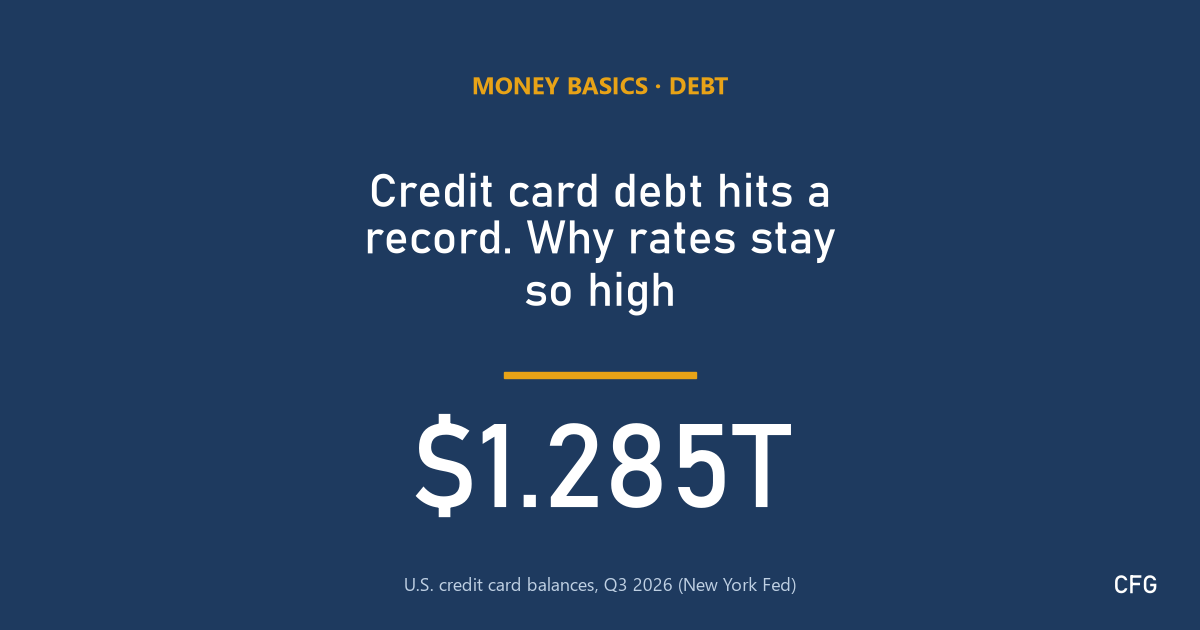
The New York Fed reported on November 10 that U.S. credit card balances reached $1.285 trillion, the highest ever in dollar terms. Federal Reserve data puts the average rate on cards that charge interest at about 22%.
This guide explains why U.S. rates are so high, what a $6,000 balance costs at that rate, and the moves that can cut the bill.
Key takeaway
Card balances reached $1.285 trillion in Q3 2026, and the average rate on accounts charged interest was 22.36% in August, about 18.7 points above that month’s federal funds rate. At that rate, a $6,000 balance paid with a minimum-style payment (interest plus 1% of the balance) can take about 21 years to clear. The same balance paid at a fixed $250 a month takes 33 months.
Key numbers
| Item | Figure |
|---|---|
| Credit card balances, Q3 2026 | $1.285 trillion (up $22 billion from Q2) |
| Total household debt, Q3 2026 | $19.105 trillion |
| Cards moving into serious delinquency (90+ days), Q3 2026, annualized | 6.87% (7.05% a year earlier) |
| Average rate, accounts charged interest, Aug 2026 | 22.36% |
| Federal funds rate, Aug 2026 | 3.63% (3.88% in Oct 2026, after a September hike) |
| Average APR margin over the index rate, 2024 | 16.4 points (highest in CFPB data since 2015) |
| Interest charged on cards in 2024 | $160 billion |
| General-purpose cardholders paying only the minimum, 2024 | About 15% |
| EU cap on consumer credit card interchange | 0.3% of the transaction |
Sources: New York Fed (Nov 10, 2026); Federal Reserve G.19 and H.15 via FRED (accessed Nov 15, 2026); CFPB Consumer Credit Card Market Report, 2025; Regulation (EU) 2015/751.

Is $1.285 trillion really a record?
In dollars, yes. Balances rose $22 billion in a quarter and $52 billion in a year, and the New York Fed’s report shows 5.0% of all household debt in some stage of delinquency.
But dollars aren’t the whole story. Card balances peaked near $870 billion in 2008. Adjusted with the Consumer Price Index, that is roughly $1.34 trillion in September 2026 dollars, a little above today’s balance.
So it’s a nominal record, not a record once prices are counted. Fewer cards are going bad, too: the share of card balances moving into serious delinquency slipped from 7.05% to 6.87% in a year.
Age matters for this audience. On the New York Fed’s age chart, serious card delinquency for people in their 60s and 70+ looks like roughly 5% to 6%, versus about 10% for borrowers under 30. That’s a reading from a chart, not a published table, so treat it as approximate.
Why are U.S. card rates so high?
Two things stack on top of each other. First, card rates float with the central bank’s rate. Second, issuers add a large margin on top.
Here’s the gap over time:
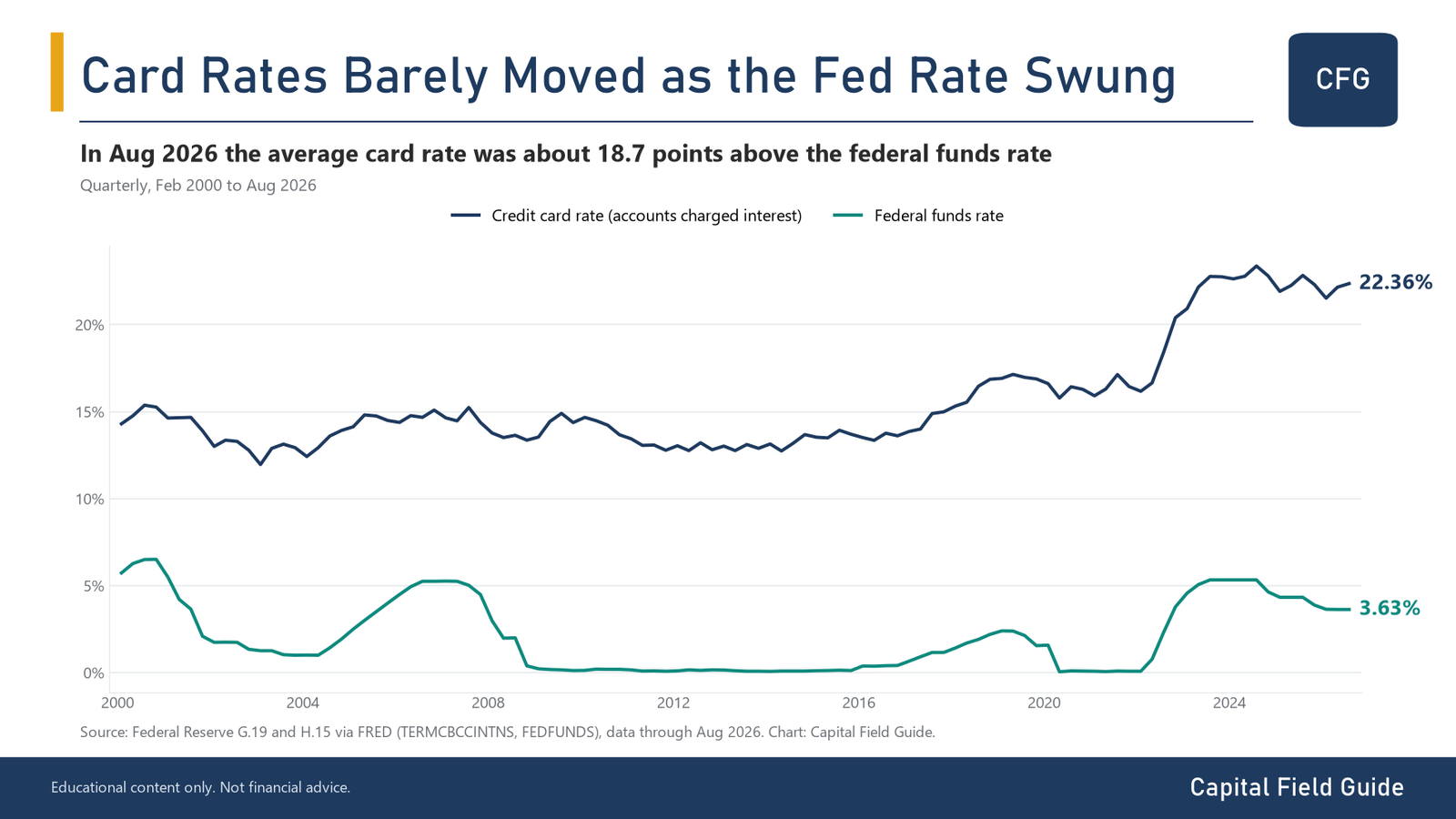
The Fed cut rates from their 2023 peak, yet the average card rate barely moved: 22.77% in August 2023, 22.36% in August 2026. Meanwhile the federal funds rate fell from 5.33% to 3.63%. (The Fed then raised its target range a quarter point, to 3.75%-4.00%, in September 2026; the effective rate was 3.88% in October.)
The CFPB explains why. A card’s APR is an index (usually the prime rate) plus a margin the issuer chooses. The average margin reached 16.4 points in 2024, up more than 3 points since 2015. For new accounts it was 19.2 points. When the index falls, the margin stays.
Part of that margin pays for losses. Roughly half of accounts carry a balance from month to month, and some borrowers never repay. The CFPB says issuers set margins by weighing credit risk, funding and marketing costs, and profit goals, and it doesn’t split them out. Issuers charged $160 billion in interest in 2024.
Who pays for card rewards?
Here’s the “rewards are free” misconception. Rewards are partly funded by interchange fees, which merchants pay on every card sale. The Richmond Fed puts typical credit card interchange at 1% to 3% of the transaction.
Most merchants don’t charge card users a different price. A 2010 Boston Fed study found that this spreads the cost of fees and rewards across all shoppers, including people who pay with cash. That study is old, and industry-funded researchers dispute how large the transfer is, but the basic mechanism hasn’t changed: U.S. credit card interchange isn’t capped.
Europe went the other way. Regulation (EU) 2015/751 caps consumer credit card interchange at 0.3% and consumer debit at 0.2%. That leaves card issuers there with far less fee income to pay for points.
Does that make Europeans more disciplined? We couldn’t find a source showing it does. A simpler explanation is that the payment system’s economics differ: U.S. cards pay you to swipe, and the interest from people who carry balances helps fund that.

What does a $6,000 balance really cost?
Take $6,000 at 22.36%, the August average. Interest for the first month is $6,000 × 0.2236 ÷ 12 = $111.80. That’s about $1,342 a year in interest alone if the balance never moves.
Now two ways to pay it down, with no new purchases:
- Minimum-style payment (interest plus 1% of the balance, $25 floor): the first payment is $171.80, then it shrinks. Payoff takes 249 months, about 20.8 years, and you pay about $10,105 in interest.
- Fixed $250 a month: payoff takes 33 months, and interest is about $2,027.
- Fixed $500 a month: payoff takes 14 months, with about $855 in interest.
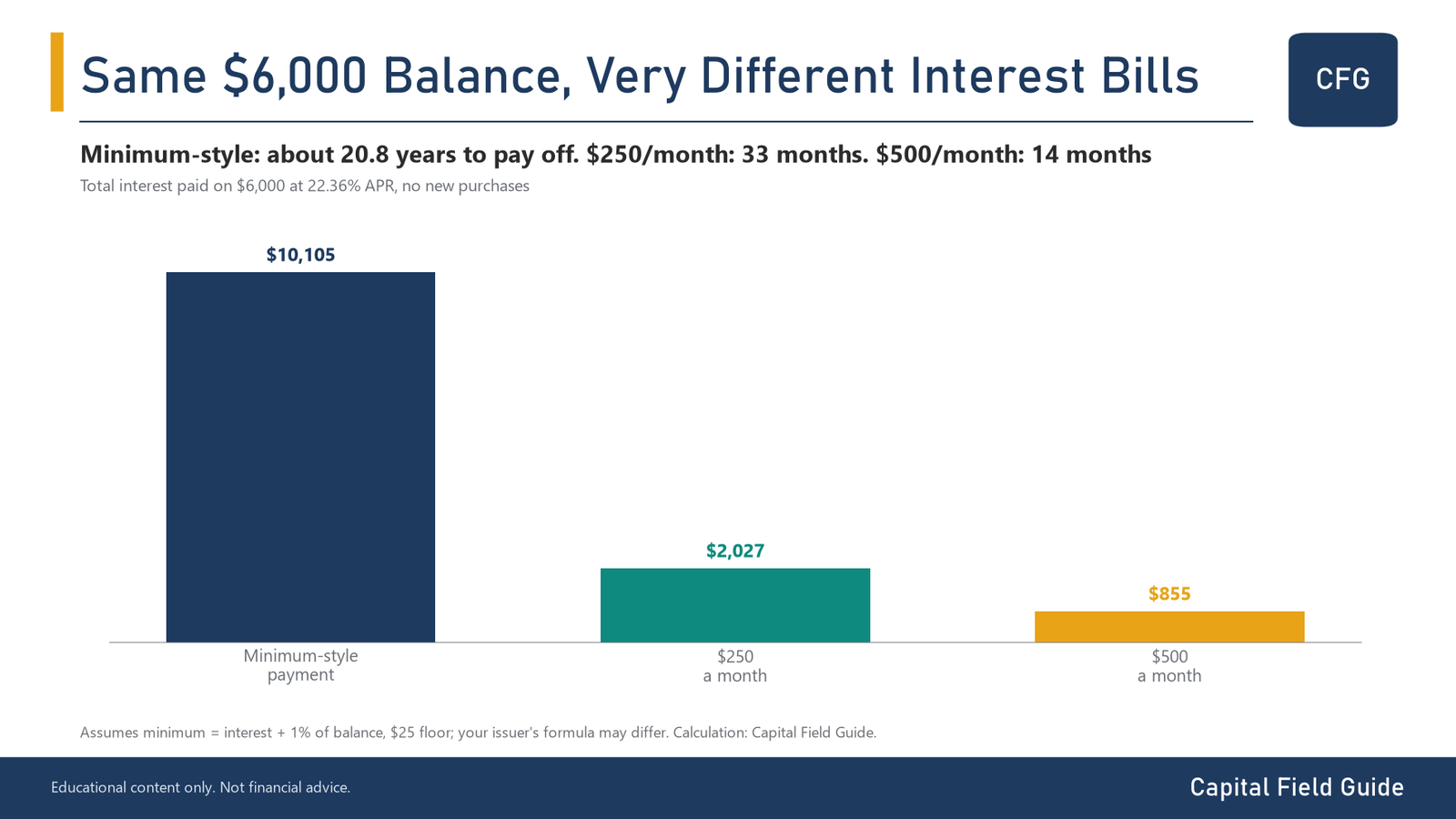
The 1% formula is an assumption, because issuers set their own. Your statement has the exact figures. Federal rules require a “Minimum Payment Warning” box that shows how long minimum-only payments would take, the total cost, and the monthly payment that clears the balance in 36 months.
Is a 10% rate cap coming?
Not yet. Two bills, S. 381 in the Senate and H.R. 1944 in the House, would cap card rates at 10%. The Senate bill was introduced February 4, 2025 and referred to the Banking Committee. The House bill was introduced March 6, 2025 and referred to the Financial Services Committee.
On November 15, 2026, Congress.gov’s latest action for each was still that committee referral. Neither is law, and neither has passed a chamber. Planning around a cap that may never arrive isn’t a strategy.
Our read: what we’d watch
Our read
This is our opinion, not financial advice.
We think the biggest lever for most people isn’t the rate. It’s the payment. Rates move slowly and mostly out of your hands, but a fixed payment above the minimum is a choice you can make this month. The gap between 21 years and 33 months comes from that choice.
The Fed raised its target range by a quarter point on September 16, 2026, to 3.75%-4.00%, and the effective federal funds rate was 3.88% in October. If rates fall again, we’d expect card rates to follow only slowly, because the 16.4-point margin is the part that hasn’t moved. If rates hold or rise, there is little room for card rates to drop. If a rate cap passed, issuers could respond by tightening credit or adding fees, which is the argument opponents make. We can’t say which would win out.
What we’d watch: the next New York Fed report, the G.19 rate each quarter, and whether the cap bills get a hearing.
What some borrowers do about a balance
Practical steps
1. Read the last statement. Some people start with two spots: the APR and the Minimum Payment Warning box.
2. Some people pay the statement balance in full when they can. Most cards offer a grace period, meaning no interest on new purchases when the full statement balance is paid by the due date (your card agreement spells out the terms). Autopay for that amount helps avoid missed dates.
3. Ask for a lower rate. Some borrowers call the issuer and ask. The worst answer is no, and the call is free.
4. Some run the balance-transfer math. A 0% transfer card often charges a fee of 3% to 5%, which would be $180 to $300 on $6,000. It can beat $2,027 of interest, but only if the balance is cleared before the promo ends, and a payment more than 60 days late can raise the rate on everything.
5. Some look at credit unions. Federal credit unions can’t charge more than 18% on loans under an NCUA ceiling, extended through September 10, 2027. It’s a ceiling, not a guaranteed rate, and state-chartered credit unions follow state rules.
6. Some try nonprofit credit counseling. The National Foundation for Credit Counseling lists debt management plans among its services, which can include lower rates.
7. Some pick a payoff order. Avalanche (highest rate first) minimizes interest. Snowball (smallest balance first) gives quicker wins. Either works if you stick to it.
8. Some weigh the risks of tapping a 401(k) or home equity. A 401(k) hardship withdrawal is generally taxed as income (Roth contributions aside), may carry a 10% additional tax for people under 59½, and can’t be paid back into the plan. A HELOC uses your house as collateral, so falling behind could cost you the home.
FAQ
Is it better to pay the minimum or a fixed amount?
A fixed amount, for people whose budget allows it. In our example, $250 a month cuts the payoff from about 21 years to 33 months and saves roughly $8,000 in interest.
Why didn’t my rate fall when the Fed cut rates in 2024 and 2025?
Most cards use the prime rate plus a margin. Prime moves with Fed decisions, but the margin is set by the issuer, and it reached 16.4 points in 2024, the highest in the CFPB’s data, which starts in 2015.
Will a 10% cap lower my rate?
Not today. The bills are in committee and aren’t law.
What if I can’t make even the minimum?
Some borrowers call the issuer’s hardship line or a nonprofit credit counselor early. Our earlier guide covers what happens when payments stop.
The bottom line
Card debt is at a record in dollars, but rates are the bigger story for anyone on a fixed income. A margin of about 16 points on top of the prime rate keeps U.S. rates near 22%.
A fixed payment above the minimum, a lower rate, or a 0% transfer can each cut years off a balance. A 10% cap isn’t law, so these are the levers that exist today.
A $6,000 balance can cost $2,027 or $10,105 in interest. The difference is how you pay it.
What’s your card’s APR, and have you ever asked the issuer to lower it? Tell us in the comments.
Further reading: What Really Happens If You Stop Paying Your Credit Card? The Timeline, the Lawsuit Risk, and What They Can’t Touch
Sources
– Federal Reserve Bank of New York, Household Debt and Credit Report, Q3 2026 and report PDF (Nov 10, 2026)
– Federal Reserve Bank of New York, Household Debt and Credit Report, Q4 2018 (Feb 12, 2019; 2008 nominal peak)
– Federal Reserve G.19 via FRED, Commercial Bank Interest Rate on Credit Card Plans, Accounts Assessed Interest (TERMCBCCINTNS)
– Federal Reserve H.15 via FRED, Effective Federal Funds Rate (FEDFUNDS)
– BLS via FRED, Consumer Price Index, CPIAUCSL
– CFPB, Consumer Credit Card Market Report, 2025
– Richmond Fed, Should Credit Card Fees Be Regulated? (Econ Focus, Q4 2025)
– Boston Fed, Who Gains and Who Loses from Credit Card Payments? (2010)
– EU, Regulation (EU) 2015/751, Articles 3 and 4
– Congress.gov, S. 381, 10 Percent Credit Card Interest Rate Cap Act and H.R. 1944
– NCUA, Letter 26-FCU-02, Permissible Loan Interest Rate Ceiling Extended
– eCFR, 12 CFR 1026.7(b)(12), Minimum Payment Warning
– CFPB, How to find the best credit card and Credit cards key terms
– National Foundation for Credit Counseling, nfcc.org
– IRS, Retirement topics: hardship distributions
Rates and rules change. Check your card agreement, Congress.gov and the NCUA before acting.
Disclaimer: This content is for general information and education only. It is not a recommendation to buy or sell any security, and it does not consider your personal financial situation. Investing involves risk, including possible loss of principal. You are responsible for your own investment decisions. Capital Field Guide and its authors are not liable for any losses or damages arising from the use of this information. Consider consulting a licensed financial, tax, or legal professional before acting.