This article is for educational purposes only and is not investment, tax, or legal advice. Read our Disclaimer.
Last reviewed: November 20, 2026. Sources are listed at the end.
You’ve seen the ads: guaranteed income for life, a check that never stops. You’ve also heard the other side, that annuities are expensive and the money is gone if you change your mind. Both fears are reasonable.
This post puts real numbers on one question: what does $100,000 pay a 65-year-old from an immediate annuity? Then it covers what that check is made of, what inflation does to it, and what to check before signing.
We read recent public quote tables and official pages on November 19 and 20, 2026. We don’t name or recommend any insurer or product.
Key takeaway
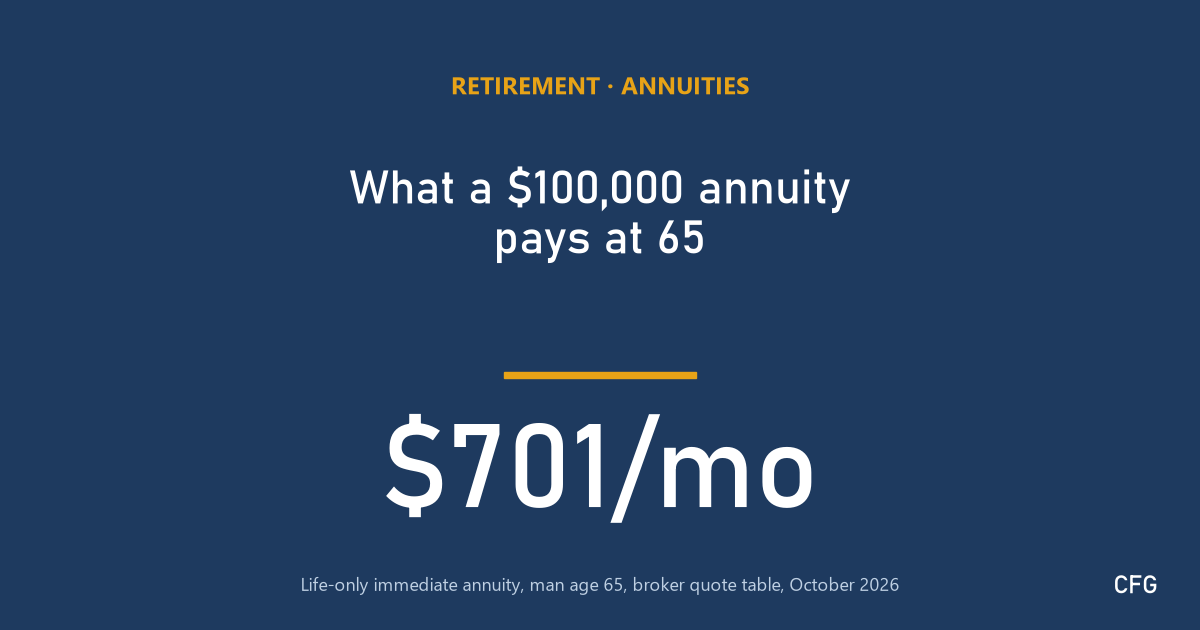
In one October 2026 broker table, $100,000 bought a 65-year-old man about $701 a month for life ($8,412 a year) and a 65-year-old woman about $672. A September 2026 estimate was lower, about $625 for a man. Either way, much of every check is your own money coming back, so the payout rate is not a yield. And a level check loses buying power: it takes about $1,960 today to buy what $1,000 bought in 2000.
Key numbers
| Item | Figure | Date |
|---|---|---|
| Immediate annuity, man age 65, life only, per $100,000 | $701 a month ($8,412 a year, 8.4% of premium) | Oct 2026 |
| Same, woman age 65 / couple both 65 (joint life) | $672 / $622 a month | Oct 2026 |
| Another estimate (CBS News, citing Annuity.org), man / woman / couple 65 | $625 / $590 / $536 a month | Sep 2, 2026 |
| Break-even for a man at 65 ($100,000 divided by yearly payout) | about 11.9 years (age 77) | Our calculation |
| Example 5-year MYGA rates on one broker’s pages | 5.85% (A+ rated insurer, $100,000 minimum, MVA) and 6.50% compounded (B+ rated); others listed higher or lower | Nov 19, 2026 |
| 10-year Treasury yield | 5.10% | Nov 17, 2026 |
| 2026 QLAC premium limit | $210,000 | IRS Notice 2025-67 |
| Typical state guaranty limit on annuity benefits | $250,000 present value, varies by state | NOLHGA |
Sources: My Annuity Store; CBS News (citing Annuity.org); FRED; IRS; NOLHGA (accessed Nov 19-20, 2026). Quote tables are broker estimates, not offers.

What does $100,000 pay at ages 60 to 75?
An immediate annuity (SPIA) is a one-time purchase that starts paying within about a year, according to FINRA and the NAIC. Here are life-only quotes per $100,000 from one broker’s October 2026 table:
| Age | Man (monthly) | Woman (monthly) | Couple, joint life (monthly) | Man, years to break even |
|---|---|---|---|---|
| 60 | $658 | $638 | $597 | 12.7 |
| 65 | $701 | $672 | $622 | 11.9 |
| 70 | $771 | $738 | $661 | 10.8 |
| 75 | $895 | $849 | $732 | 9.3 |
Source: My Annuity Store, “as of October 2026” (page updated Oct 18, 2026). Break-even = $100,000 divided by 12 times the monthly check (our calculation). State premium taxes, if any, are not shown.
Here’s what that looks like as yearly income for a man:
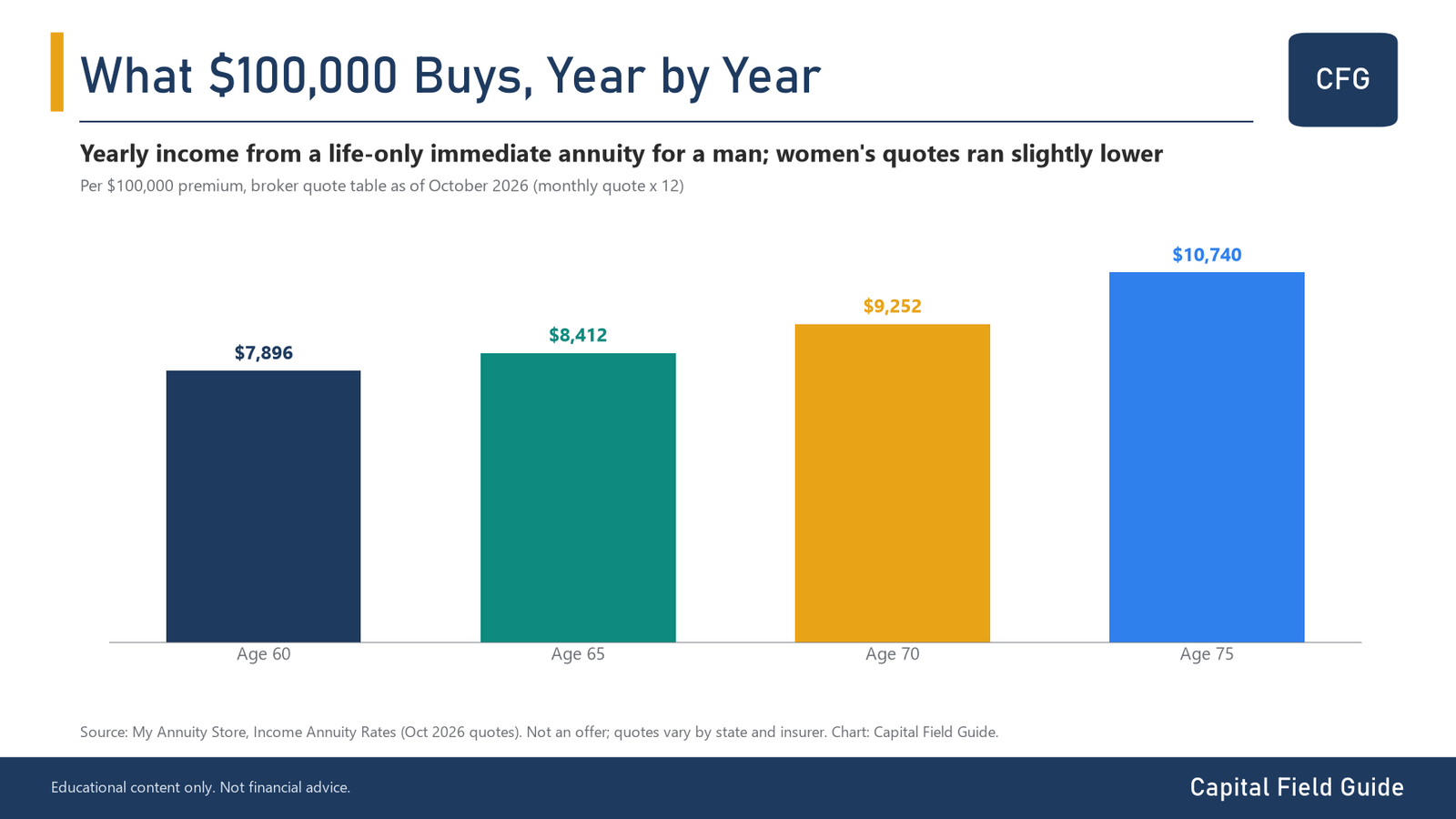
Source: My Annuity Store, Oct 2026, life-only single quotes; annual = monthly times 12. Chart: Capital Field Guide.
Two cautions. First, sources disagree. A September 2, 2026 CBS News piece citing an Annuity.org analysis put a 65-year-old man at about $625 a month per $100,000 and a woman at $590. It put a 65-year-old couple, joint life, at about $536, well below the $622 in the table above. Quotes depend on state, which insurers are included, and whether a figure is the best one or an average.
Second, a life-only check stops when you die. Adding a refund feature lowers it. The same broker’s table shows $671 instead of $701 for a 65-year-old man with an installment refund.
What is the check actually made of?
A payout rate of 8.4% sounds like a great yield. It isn’t, because the check has three parts:
- Interest the insurer earns on your premium.
- Your own principal, paid back a little at a time.
- Mortality credits: money from people in the pool who die earlier than average, which helps pay those who live longer.
Here’s a simple test. If you spent $100,000 evenly over 25 years (to age 90) while earning the current 10-year Treasury yield of 5.10%, you’d draw about $590 a month. Over 30 years, about $543. The $701 quote is higher than both. Spread over 18 years, about a 65-year-old man’s life expectancy, the same $100,000 gives roughly $708 a month. The annuity’s edge is that it keeps paying if you live past that. In our simplified illustration, the gap is roughly what pooling adds, before the insurer’s costs and its own investment results.
That also explains why rates matter. The 10-year yield averaged 3.66% in 2008, 1.80% in 2012 and 0.89% in 2020, then 4.55% so far in 2026 (FRED). We couldn’t find a dated public history of payout quotes, so we won’t put numbers on how payouts moved. The direction follows from the math: when yields are low, the same $100,000 buys less income, and when they’re higher, more.
Here’s the 10-year yield since 2000:
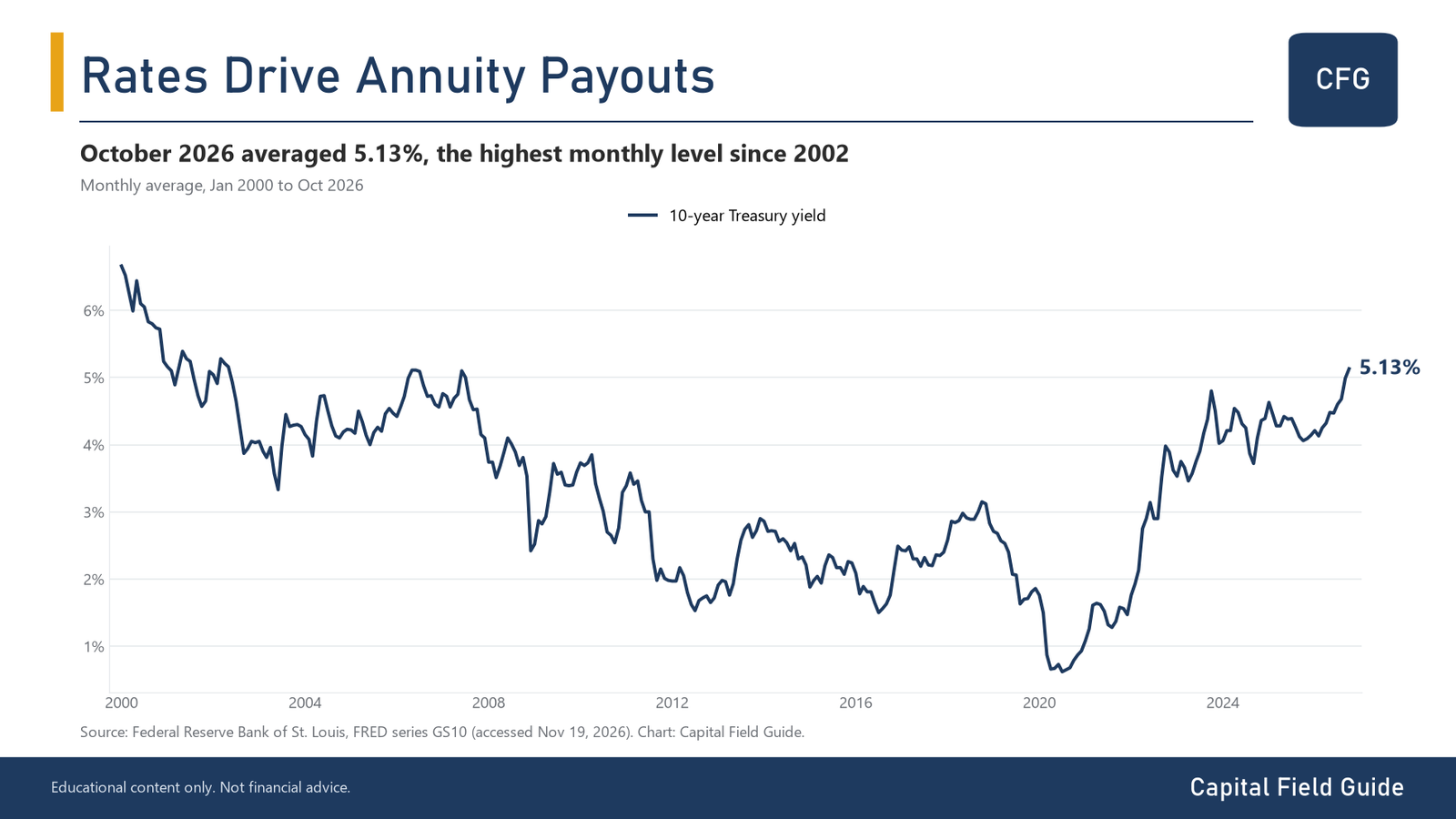
Source: FRED, series GS10, monthly average. Chart: Capital Field Guide.
October’s 5.13% average was the highest monthly reading since 2002, and the daily rate was 5.10% on November 17. Higher yields are one reason a 65-year-old sees $600 to $700 per $100,000 on the table, though we can’t measure how much.

What does inflation do to a level check?
A fixed check doesn’t rise. The BLS consumer price index (CPI-U, not seasonally adjusted, via FRED) averaged 172.2 in 2000 and was 337.511 in October 2026. So it takes about $1,960 today to buy what $1,000 bought in 2000. Put the other way, a flat $1,000 now buys about 51% of what it did then (our calculation).
For a retiree, that’s the cost of a level check. If prices rose 2.6% a year, the 2000 to 2026 average, a $701 check at 65 would buy about what $369 buys today by age 90. That’s a hypothetical, not a forecast. Some contracts offer annual increases, but they generally start with a lower first check, so compare the two in dollars.
How does a SPIA compare with a MYGA or a QLAC?
They solve different problems.
- MYGA (multi-year guaranteed annuity): works like a CD from an insurer. On November 19, 2026, one broker’s pages listed 5.85% for a 5-year contract with a market value adjustment (A+ rated insurer, $100,000 minimum) and 6.50% compounded from a B+ rated insurer. Other listings were higher (including a state-limited, simple-interest contract) or lower, so treat these as examples, not the best available. At 5.85%, $100,000 earns about $5,850 in year one, and your principal is still there. A SPIA’s $8,412 includes principal, so the two numbers aren’t comparable. A MYGA doesn’t pay for life, and surrender charges can apply.
- QLAC (qualifying longevity annuity contract): a deferred income annuity bought inside an IRA or 401(k) that starts paying later. The 2026 premium limit is $210,000 per person across all QLACs (IRS Notice 2025-67). SECURE 2.0 removed the older rule that capped QLAC purchases at 25% of the account balance. Its value is excluded from the balance used to figure required minimum distributions until payments start. We found no dated public quote table for deferred income annuities, so we don’t give a payout figure.
- Delaying Social Security: SSA’s delayed retirement credit adds 8% a year (two-thirds of 1% a month) for people born in 1943 or later, up to age 70. Some planners treat that as a low-cost way to buy more lifetime income. That’s a framing, not a rule, and it depends on your health and what you’d live on while you wait.
How are annuity payments taxed?
It depends on whose money it is. With after-tax money (a nonqualified annuity), the IRS says you don’t pay tax on the part of each payment that returns your investment in the contract, and the “general rule” sets that split using IRS life-expectancy tables (Topic 411, Publication 939). With pre-tax IRA or 401(k) money, there’s no after-tax cost to recover, so payments are generally fully taxable as ordinary income (Publication 575). With after-tax money, once you’ve recovered your full investment, the rest of each payment is generally taxable too (Topic 411).
Our read: what we’d watch
Our read
This is our opinion, not financial advice. We don’t predict rates.
If your main worry is outliving your money, a SPIA is the product built for exactly that. Pooling is what lets it pay more than the interest-only math above.
If you’d want the money back in an emergency, be careful. You trade flexibility for the check, so buying with only part of your savings is a common middle path.
If rates fall, quotes for the same $100,000 would likely be lower; if they rise, higher. Some people buy in steps for that reason. We can’t tell you which way yields go.
If you can wait, the check is bigger: the table above pays $771 at 70 versus $701 at 65, though you’d collect for five fewer years.
Here’s what we’d watch: quotes from at least three insurers, each insurer’s financial strength, and how much of your income is already guaranteed.
What are the traps?
Watch out
High commissions and fees. FINRA says annuities come with a variety of fees and that sales commissions can be high. Ask for the commission in writing.
Surrender charges. FINRA describes them as a penalty for selling or withdrawing during the surrender period. Check this on a MYGA or any deferred contract.
Riders and add-ons. A feature such as inflation increases usually lowers the starting check. Ask for the price of each option.
The insurer. FINRA says the guarantee lasts only as long as the insurer stays in business. State guaranty associations may step in if it fails, but NOLHGA lists $250,000 in present value of annuity benefits in most states, and limits vary. Check yours.
The free-look window. FINRA says it is typically 10 to 30 days, set by the state, and lets you cancel without surrender charges. Read the contract during it.
What some retirees do first
Practical steps
1. Find the income gap. Some retirees add up Social Security and any pension, subtract that from yearly spending, and look only at what’s left.
2. Get several written quotes. They ask multiple insurers for the same age, state and options, then compare the payout, the insurer’s rating and the fees.
3. Test it against inflation. Some compare a level check with one that rises, and count how many years it takes the rising one to catch up.
4. Price the Social Security option. Some check what waiting until 70 would add before spending savings on an annuity.
5. Keep a reserve. Money that can’t be reversed is often only part of the plan.
FAQ
How much does a $100,000 annuity pay per month at 65?
In the sources we checked, about $625 to $701 for a man and $590 to $672 for a woman, life only, depending on the source and date.
Is the payout rate a return?
No. It includes your own principal and pooling, so it can’t be compared with a CD or bond yield.
What happens if I die early?
With a life-only SPIA, payments stop. A refund or period-certain option can pay your heirs but lowers the check.
Is my annuity insured like a bank deposit?
No. State guaranty associations, not the FDIC, may cover it, up to limits that vary by state. NOLHGA lists $250,000 in present value in most states.
Does a QLAC change my RMDs?
Yes. Its value is excluded from the balance used to figure RMDs until payments start, up to the $210,000 premium limit for 2026.
The bottom line
A $100,000 income annuity at 65 pays roughly $600 to $700 a month today, and much of each check is your own principal coming back.
An annuity buys certainty with your flexibility, and a level check buys less every year. Get the quotes, the fees and the insurer’s strength in writing before you decide.
Next: Why Retirees Don’t Spend Their Savings
Sources
– My Annuity Store, Income Annuity Rates: SPIA and Income Rider Payouts by Age (SPIA quotes as of Oct 2026; page updated Oct 18, 2026)
– CBS News, How much will a $100,000 annuity pay each month in 2026? (Sep 2, 2026; cites Annuity.org estimates)
– My Annuity Store, 5-year fixed annuity rates and its carrier rate pages (rates updated Nov 19, 2026)
– FRED, 10-Year Treasury Constant Maturity Rate (DGS10)
– FRED / BLS, Consumer Price Index for All Urban Consumers, not seasonally adjusted (CPIAUCNS)
– IRS, Notice 2025-67, 2026 retirement plan limits (QLAC)
– IRS, Instructions for Form 1098-Q (QLAC rules)
– IRS, Topic no. 410, Pensions and annuity income and Topic no. 411, Taxation of the distribution of annuities; Publication 939 and Publication 575
– FINRA, Annuities
– NAIC, Annuities
– NOLHGA, Policyholder FAQ
– SSA, Delayed retirement credits (Benefits Planner)
Quotes, rates and tax rules can change. Check the sources before acting.
Disclaimer: This content is for general information and education only. It is not a recommendation to buy or sell any security or insurance product, and it does not consider your personal financial situation. Annuity guarantees depend on the claims-paying ability of the issuing insurer, and investing involves risk, including possible loss of principal. You are responsible for your own financial decisions. Capital Field Guide and its authors are not liable for any losses or damages arising from the use of this information. Consider consulting a licensed financial, tax, or legal professional before acting.