This article is for educational purposes only and is not financial, tax, or legal advice. Read our Disclaimer.
Last reviewed: November 9, 2026. Sources are listed at the end.
A 3.6% raise sounds nice until you remember what a gallon of gas cost you this spring.
That’s the tension every retiree feels right now. The Social Security Administration confirmed a 3.6% cost-of-living adjustment (COLA) for 2027, up from 2.8% for 2026. Checks go up starting with January 2027 benefits. SSI payments rise starting December 31, 2026.
So how much is that, really? And how much of it will you actually get to keep?
Key takeaway
The 3.6% COLA adds about $75 a month for the average retired worker, starting with January 2027 benefits. Medicare Part B could take back part of it (the 2027 premium isn’t final yet), and a bigger check can make more of your benefit taxable.
Key numbers for 2027
| Item | 2026 | 2027 |
|---|---|---|
| Cost-of-living adjustment | 2.8% | 3.6% |
| Average retired worker benefit | $2,095 | $2,170 (est.) |
| Average aged couple, both receiving | $3,238 | $3,355 (est.) |
| Maximum benefit at full retirement age¹ | $4,152/mo | $4,188/mo |
| Earnings limit, under full retirement age | $24,480 | $25,560 |
| Earnings limit, year you reach full retirement age | $65,160 | $67,920 |
| Maximum earnings subject to Social Security tax | $184,500 | $192,300 |
| SSI federal payment, individual / couple | $994 / $1,491 | $1,029 / $1,544 |
Source: SSA 2027 COLA Fact Sheet. Average figures are SSA estimates for January 2027.
¹ The maximum for a worker retiring at full retirement age rises less than 3.6% because it’s set by a separate benefit formula for new retirees, not by the COLA.

What 3.6% looks like in real dollars
For the typical retired worker, the raise works out to about $75 a month.
Here’s how it breaks down for different households:
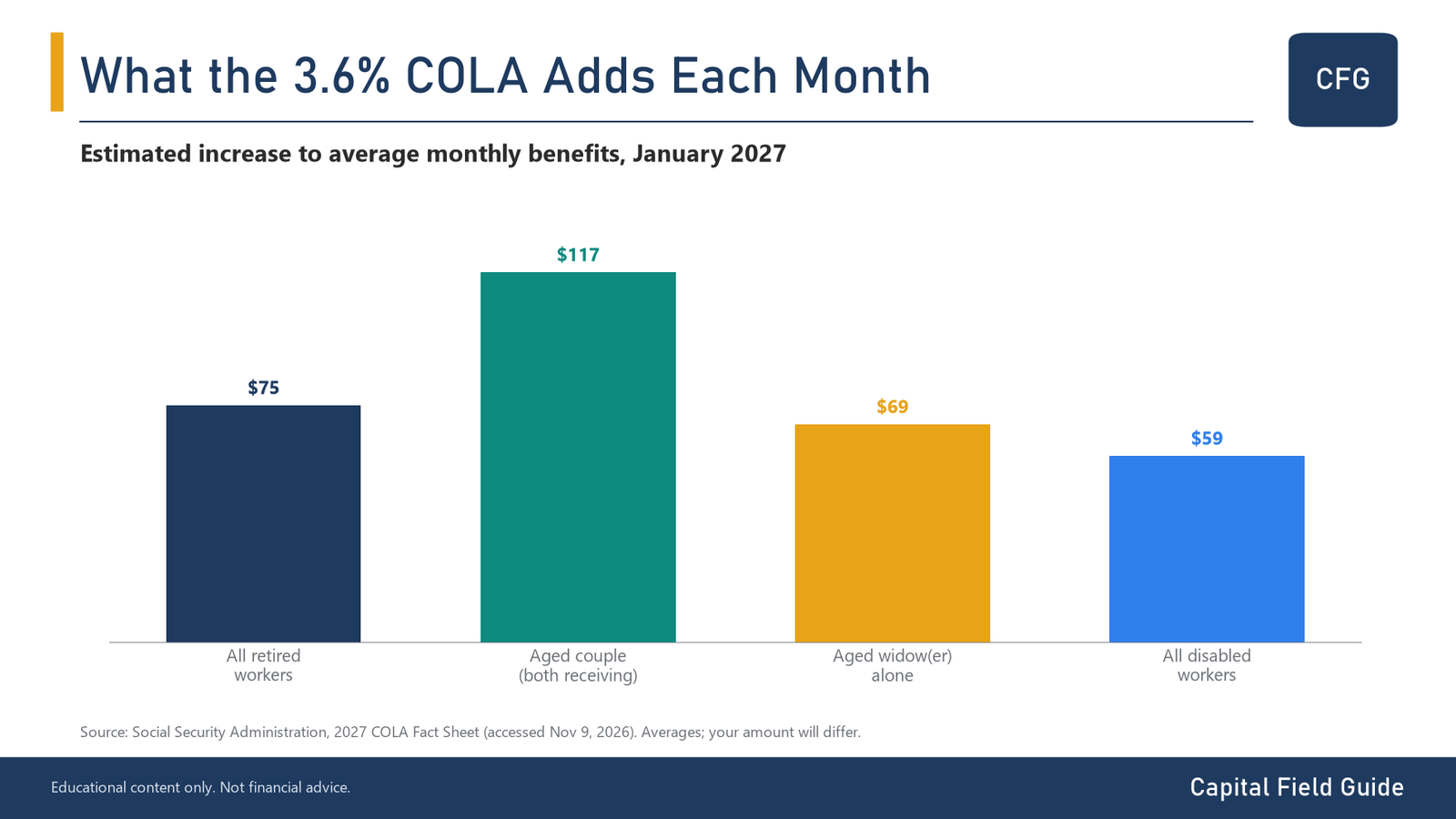
Seventy-five dollars won’t change anyone’s life.
But it’s not nothing either. Over a year that’s about $900, and because every future COLA is calculated on top of this new, higher base, the raise keeps compounding for as long as you collect.
Why the raise is 3.6% and not more
The COLA is tied to one specific inflation gauge, the CPI-W, which tracks prices for urban wage earners and clerical workers. SSA compares the average for July through September this year with the same months last year.
That’s the first thing worth understanding: the formula measures what workers buy, not what retirees buy.
Retirees spend a bigger share of their money on health care and housing. Those costs often rise faster than the overall index. Economists have argued about this for decades, and there’s an experimental index built for older Americans (the CPI-E) that has historically run slightly higher, though the gap has narrowed in recent years. Congress has never switched to it.
So if your personal inflation feels higher than 3.6%, you’re probably not imagining it.
The part nobody puts in the headline: Medicare
For most people on Medicare, the Part B premium comes straight out of the Social Security check.
As of today, the official 2027 Part B premium hasn’t been announced. The Medicare Trustees projected it at about $209.50 a month, up from $202.90 in 2026, with the annual deductible rising to about $292. Some private forecasts run higher. CMS usually publishes the final number in the fall, so watch for it.
If the Trustees’ estimate holds, about $6.60 of your $75 raise goes right back to Medicare.
There’s a safety net here that many people don’t know about. Under the “hold harmless” rule, most people whose Part B premium is deducted from their Social Security check can’t see their net benefit go down because of a premium increase. It protects the size of your check, not the size of your raise. It also doesn’t apply to everyone, including higher-income beneficiaries who pay income-related surcharges.
Two Part D numbers are already final for 2027: the deductible rises to $700, and the annual out-of-pocket cap on covered drugs rises to $2,400.

History check: COLAs come in waves
Automatic COLAs started in 1975. Before that, Congress had to vote on every increase.
Since then, big raises have arrived in clusters, usually right after an inflation shock. The early 1980s brought double-digit increases. More recently, the 2023 COLA hit 8.7%, the largest in four decades, after the 2021–2022 price surge.
Here’s the uncomfortable pattern: the COLA always arrives after the pain, never before it. Prices rise first. The raise shows up the following January. When inflation is speeding up, retirees spend most of the year falling behind.
That matters this year. Oil prices spiked hard in the spring, with Brent crude topping $138 a barrel in April, and energy costs filter into everything from groceries to airfare. The 3.6% reflects inflation that already happened through September. It doesn’t know what happens next.
Our read: what we’d watch in 2027
Our read
This is our opinion, not a forecast you should bet on.
If energy prices stay high into 2027, history suggests the next COLA could be larger too, but retirees would carry the higher costs for most of the year before it arrives. If oil keeps sliding from its peak, the opposite happens: smaller COLA, but less pressure on your budget in the meantime.
Either way, the lesson from every inflation wave since the 1970s is similar. Retirees with some inflation protection outside Social Security tend to have more breathing room. That might be Treasury Inflation-Protected Securities (TIPS) or I bonds held to maturity, plus a cash cushion that keeps them from selling investments after a bad month. None of these is perfect: TIPS funds lost value when rates jumped in 2022, and cash on its own doesn’t keep up with inflation.
Four moves worth making before January
What you can do before January
1. Check your 2027 benefit notice. Most people can see their COLA notice in their my Social Security account (ssa.gov/myaccount) in late November. If you’re on Medicare, your new 2027 amount, including the Part B deduction, shows up in December. Look at the gross amount, the Medicare deduction, and the net deposit.
2. Revisit your tax withholding. A bigger check can mean a bigger tax bill if part of your benefit is taxable. The income thresholds that decide whether your benefits get taxed ($25,000 for single filers, $32,000 for joint filers, measured as “combined income”) have never been adjusted for inflation. Every COLA quietly pushes more retirees over them.
3. If you’re still working and under full retirement age, know the earnings limit. Earn more than $25,560 in 2027 and SSA holds back $1 for every $2 over. In the year you reach full retirement age, the limit is $67,920 and it’s $1 for every $3. The withheld money isn’t lost; your benefit is recalculated later. But it can wreck a monthly budget if you don’t expect it.
4. If you haven’t claimed yet, remember the biggest raise isn’t the COLA. For people born in 1943 or later, every year you wait past full retirement age (up to 70) adds 8% to your benefit, and COLAs apply to your benefit even before you claim. For anyone born in 1960 or later, full retirement age is 67.
FAQ
When will I see the 3.6% increase?
Social Security beneficiaries see it in benefits payable in January 2027. SSI recipients see it in the payment dated December 31, 2026.
Can my check go down in 2027?
For most people, a Part B premium increase can’t reduce the net Social Security payment because of the hold-harmless rule. Other changes, like tax withholding you request or income-related Medicare surcharges, can still lower your deposit.
Is the 2027 Medicare Part B premium final?
Not as of November 9, 2026. The $209.50 figure is a Trustees projection. Check Medicare.gov or CMS.gov for the official amount.
Does the COLA apply if I haven’t started benefits?
Yes. COLAs are applied starting at age 62, even if you haven’t claimed yet.
The bottom line
A 3.6% raise is a real raise, and it compounds.
It just isn’t a reason to relax. Check what Medicare takes, check what the IRS will want, and make sure you have at least one source of income that doesn’t wait until January to catch up with prices.
A raise that arrives late is still a raise. A plan that assumes it arrives on time is a problem.
Sources
– Social Security Administration, 2027 Cost-of-Living Adjustment Fact Sheet (accessed Nov 9, 2026)
– Social Security Administration, COLA information
– CMS, 2026 Medicare Trustees Report: projected 2027 Part B premium and deductible; 2027 Part D deductible and out-of-pocket cap (accessed Nov 9, 2026)
– Federal Reserve Bank of St. Louis, FRED, Brent crude oil price (DCOILBRENTEU)
Rules and amounts can change. Confirm current figures at SSA.gov and Medicare.gov before making decisions.
Disclaimer: This content is for general information and education only. It is not a recommendation to buy or sell any security, and it does not consider your personal financial situation. Investing involves risk, including possible loss of principal. You are responsible for your own financial decisions. Capital Field Guide and its authors are not liable for any losses or damages arising from the use of this information. Consider consulting a licensed financial, tax, or legal professional before acting.