This article is for educational purposes only and is not tax or legal advice. Read our Disclaimer.
Last reviewed: November 9, 2026. Sources are listed at the end.
Same paycheck. Slightly lower tax bill.
That’s the quiet result of the IRS’s annual inflation adjustments, released November 5 in Revenue Procedure 2026-35. The tax rates didn’t change. The income ranges they apply to moved up, so a little more of your money falls into lower brackets.
These numbers apply to tax year 2027, the return most people will file in early 2028. Your 2026 return, due in April 2027, uses last year’s figures.
Key takeaway
Tax rates didn’t change for 2027, but every bracket moved up. Retirees 65+ can stack the standard deduction, a $1,700–$2,100 age add-on and the $6,000 senior deduction, and the 0% capital gains line rises to $102,100 for married couples.
The 2027 brackets
| Rate | Single | Married filing jointly |
|---|---|---|
| 10% | Up to $12,800 | Up to $25,600 |
| 12% | $12,801 – $52,025 | $25,601 – $104,050 |
| 22% | $52,026 – $109,125 | $104,051 – $218,250 |
| 24% | $109,126 – $208,325 | $218,251 – $416,650 |
| 32% | $208,326 – $264,550 | $416,651 – $529,100 |
| 35% | $264,551 – $661,375 | $529,101 – $793,650 |
| 37% | Over $661,375 | Over $793,650 |
Taxable income, after deductions. Source: IRS IR-2026-133 and Rev. Proc. 2026-35.

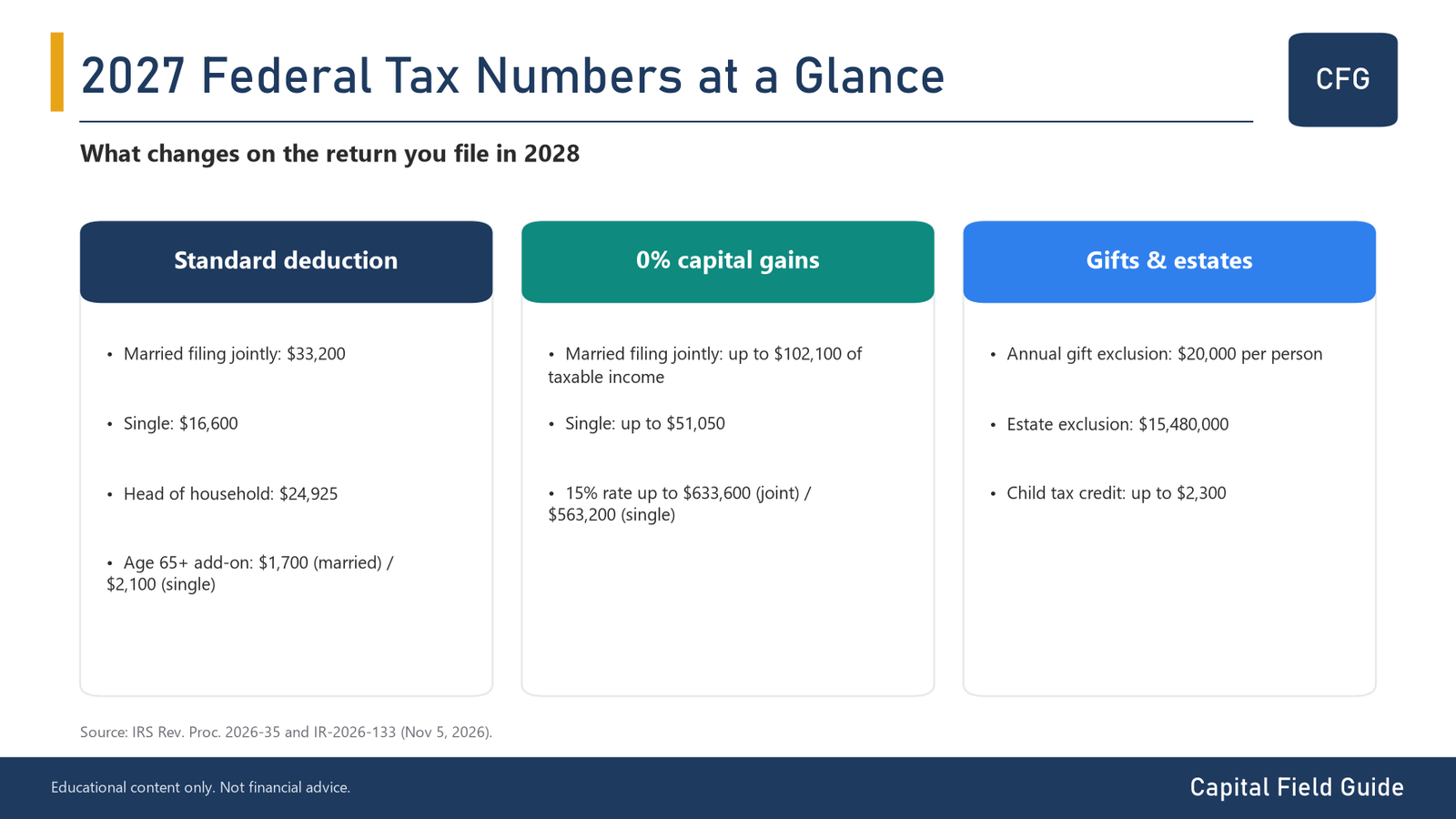
Everything else in one picture
A few of those deserve a closer look, because they’re where real money hides.
1. If you’re 65 or older, your deduction is bigger than you think
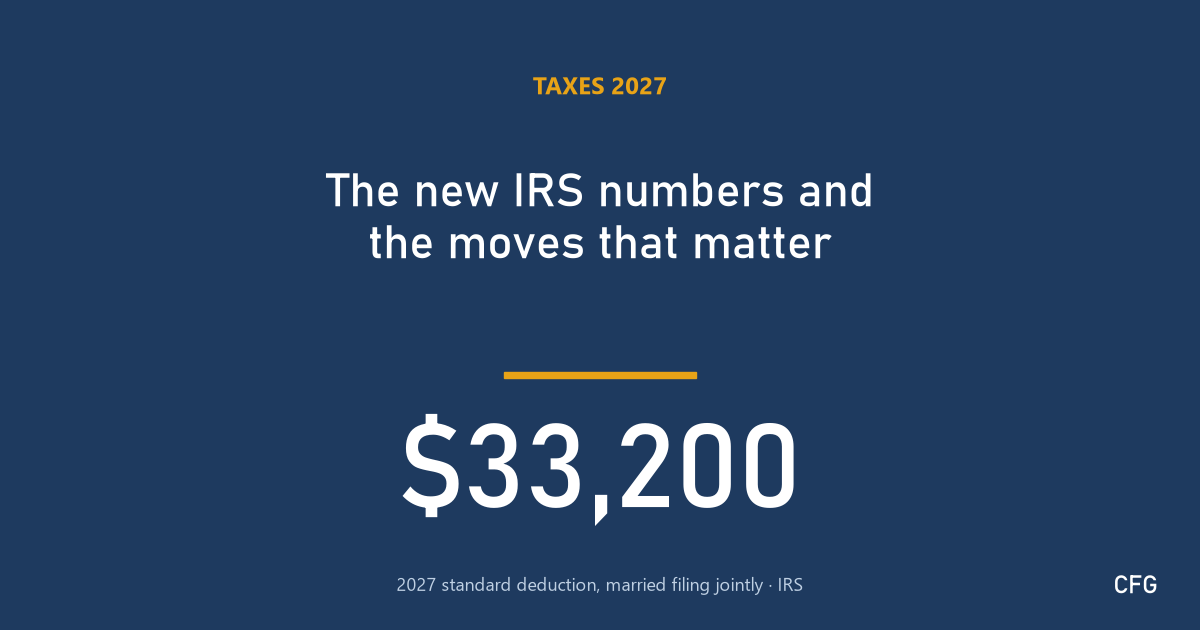
Start with the standard deduction: $16,600 for single filers and $33,200 for married couples filing jointly.
Add the extra standard deduction for age 65+: $2,100 if you’re single, $1,700 per qualifying spouse if you’re married.
Then there’s the senior deduction created by the 2025 tax law (which the IRS now describes as part of the Working Families Tax Cuts). It allows up to $6,000 per person age 65 or older, on top of the standard deduction, and it phases out for higher incomes, starting at $75,000 of modified adjusted gross income for single filers and $150,000 for joint filers. It’s scheduled to apply for tax years 2025 through 2028.
Put those together and a married couple, both over 65, with income under the phase-out could deduct well over $45,000 before paying a dollar of federal income tax.
That’s a big deal for retirees living on Social Security plus modest withdrawals.
2. The 0% capital gains bracket is the most underused gift in the tax code
In 2027, long-term capital gains and qualified dividends are taxed at 0% to the extent they fall below these taxable-income lines (the gains themselves count toward taxable income):
- $102,100 for married couples filing jointly
- $51,050 for single filers
- $68,350 for heads of household
Above those levels, the 15% rate applies up to $633,600 (joint) or $563,200 (single), and 20% above that.
Here’s why this matters. Many retirees have years where their taxable income is unusually low: after leaving work but before Social Security and required minimum distributions kick in. In those years, some investors sell appreciated stocks or funds in a taxable account, pay no federal tax on the part of the gain that fits under the 0% line, and buy back in, which resets their cost basis higher. This is often called “gain harvesting.” State taxes may still apply, and the math gets tricky if it pushes Social Security benefits into taxation, so run the numbers first.

3. Low-income years are Roth conversion years
The same logic applies to converting traditional IRA money into a Roth IRA. You pay income tax now, at today’s rates, in exchange for tax-free withdrawals later.
The 12% bracket now runs up to $104,050 of taxable income for married couples. Filling that bracket with conversions in a low-income year can make a lot of sense for people who expect higher tax rates later, through required minimum distributions, a surviving spouse filing single, or future changes in the law.
It’s not right for everyone. Conversions raise your income for the year, which can affect Medicare premiums two years later, how much of your Social Security is taxed, and, for people 65 and older, the senior deduction itself. A married couple over 65 who fills the entire 12% bracket can end up with income past the deduction’s $150,000 phase-out starting point. But conversions are one of the few tax moves where timing does most of the work.
4. Gifts and estates
The annual gift exclusion rises to $20,000 per recipient. A married couple can each give $20,000 to every child or grandchild in 2027, $40,000 per recipient in total, without owing gift tax. One detail trips people up: if the money all comes from one spouse and the couple elects to “split” the gift, a gift tax return (Form 709) is required even though no tax is due.
The estate tax exclusion climbs to $15.48 million per person. Very few families will owe federal estate tax, but state estate taxes kick in at much lower levels in some states.
Why inflation adjustments exist at all
Before 1985, tax brackets weren’t indexed to inflation. In the high-inflation 1970s, people got raises that just kept up with prices and still got pushed into higher brackets. Economists called it “bracket creep”: a stealth tax increase nobody voted for.
Indexing fixed most of that. But not everything is indexed. The income thresholds that decide whether your Social Security is taxable ($25,000 single, $32,000 joint) were set in 1983 and have never been adjusted. A second, higher tier added in 1993 ($34,000 single, $44,000 joint) hasn’t moved either. Every year of inflation pulls more retirees into paying tax on benefits. It’s bracket creep, still alive in one corner of the code.
Our read: what to plan around
Our read
This is our opinion, not tax advice.
Two things stand out to us for the next few years.
First, the senior deduction has an expiration date. As written, it covers 2025 through 2028. Temporary tax breaks sometimes get extended and sometimes don’t. There’s a trade-off hiding here: gain harvesting and Roth conversions raise your income, and higher income shrinks the senior deduction, can make more of your Social Security taxable, and can raise Medicare premiums later. Sizing those moves so they don’t cancel each other out is where careful planning, or a good tax preparer, pays off.
Second, Washington just changed. After the November midterms, control of Congress shifts in January. Tax law can only change through new legislation, which still needs the president’s signature, so the 2027 numbers above are set. But the debate over what happens to temporary provisions after 2028 is wide open. History says the safest plan is one that works under more than one version of the tax code.
FAQ
Do these numbers apply to the taxes I file in April 2027?
No. Those are 2026 taxes. The 2027 figures apply to the return most people file in early 2028.
Did tax rates go up or down?
The rates are unchanged (10% to 37%). The income thresholds rose, so most people pay slightly less tax on the same income.
Is the senior deduction automatic?
You claim it on your return if you qualify. It’s available whether you itemize or take the standard deduction, and it phases out at higher incomes. Check IRS guidance or ask a tax preparer about your situation.
The bottom line
The 2027 numbers won’t make headlines for long. They don’t need to.
The biggest wins in the tax code rarely come from new laws. They come from knowing where the 0% and 12% lines are, and having the patience to plan around them.
Further reading: Social Security’s 3.6% Raise for 2027: What Actually Lands in Your Bank Account
Sources
– IRS, IR-2026-133: IRS releases tax inflation adjustments for tax year 2027 (Nov 5, 2026)
– IRS, Revenue Procedure 2026-35, sections on tax rate tables, standard deduction, additional standard deduction for the aged or blind, and maximum capital gains rate (Nov 5, 2026)
– KPMG, Rev. Proc. 2026-35: Inflation adjustments for tax year 2027
– IRS guidance on the enhanced deduction for seniors under the 2025 tax law
– Social Security Administration, taxation of benefits thresholds
– IRS, Instructions for Form 709 (gift splitting)
Tax rules are complex and change. Confirm with IRS.gov or a qualified tax professional before acting.
Disclaimer: This content is for general information and education only. It is not tax, legal, or investment advice, and it does not consider your personal financial situation. You are responsible for your own decisions. Capital Field Guide and its authors are not liable for any losses or damages arising from the use of this information. Consider consulting a licensed tax, financial, or legal professional before acting.