This article is for educational purposes only and is not financial, tax, or real estate advice. Read our Disclaimer.
Last reviewed: November 10, 2026. Sources are listed at the end.
Here’s a question that didn’t use to need a spreadsheet: at 62, should you still own a home?
For decades, the answer for most retirees was simple. Own it, pay it off, stay put. Today a 30-year mortgage costs 7.18%, home prices have roughly doubled since 2015, and a safe one-year Treasury pays over 4%.
That combination changes the math. Not for everyone, but for more people than you’d think.
Key takeaway
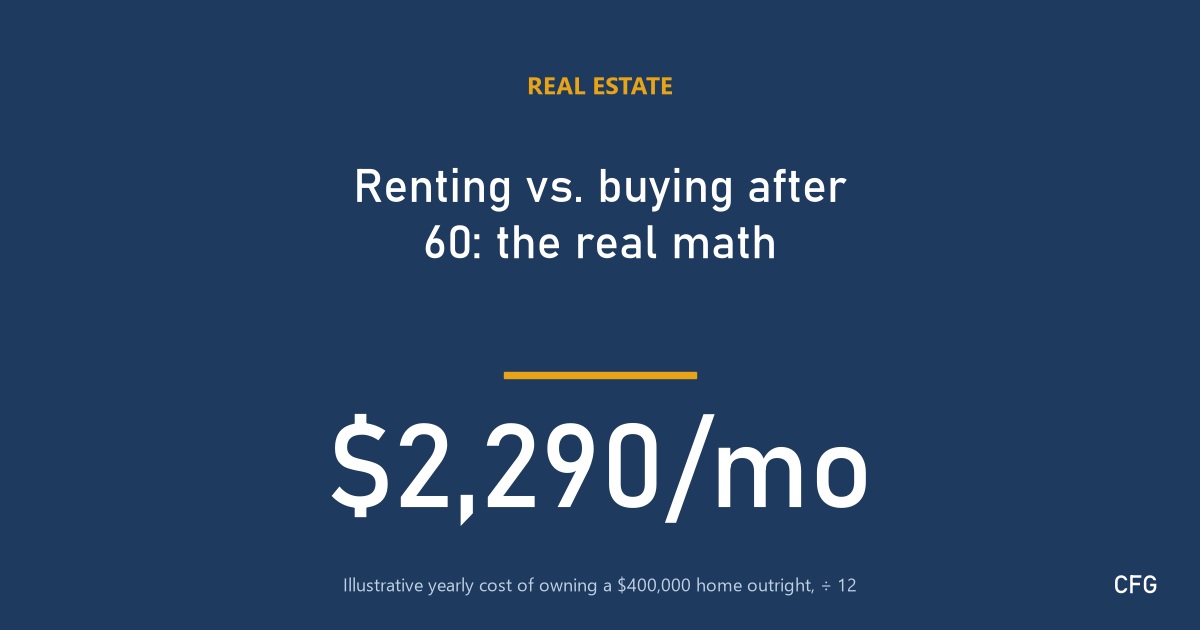
In our example, owning a $400,000 home outright costs about $27,500 a year (roughly $2,290 a month) once you count property tax, insurance, upkeep and the interest your money could have earned in Treasuries. If a comparable rental costs less and you might move within about five to seven years, renting can come out ahead. The longer you stay, the more buying and selling costs fade and the more owning tends to look better.
Key numbers
| Measure | Latest reading |
|---|---|
| 30-year fixed mortgage rate (Freddie Mac) | 7.18% (Nov 5, 2026) |
| 1-year Treasury yield | 4.28% (Nov 5, 2026) |
| Home prices, past year (Case-Shiller U.S. index, August) | +2.1% |
| Rents, past year (CPI rent of primary residence, September) | +2.8% |
| Home prices since January 2015 (through August 2026) | About +103% |
| Rents since January 2015 (through August 2026) | About +60% |
| Home sale gain you can exclude from tax | $250,000 single / $500,000 married |
Sources: Freddie Mac, U.S. Treasury, S&P CoreLogic Case-Shiller, BLS (all via FRED); IRS Publication 523.
Why this question looks different now
Home prices have run well ahead of rents for a decade.
This is the chart that explains it:
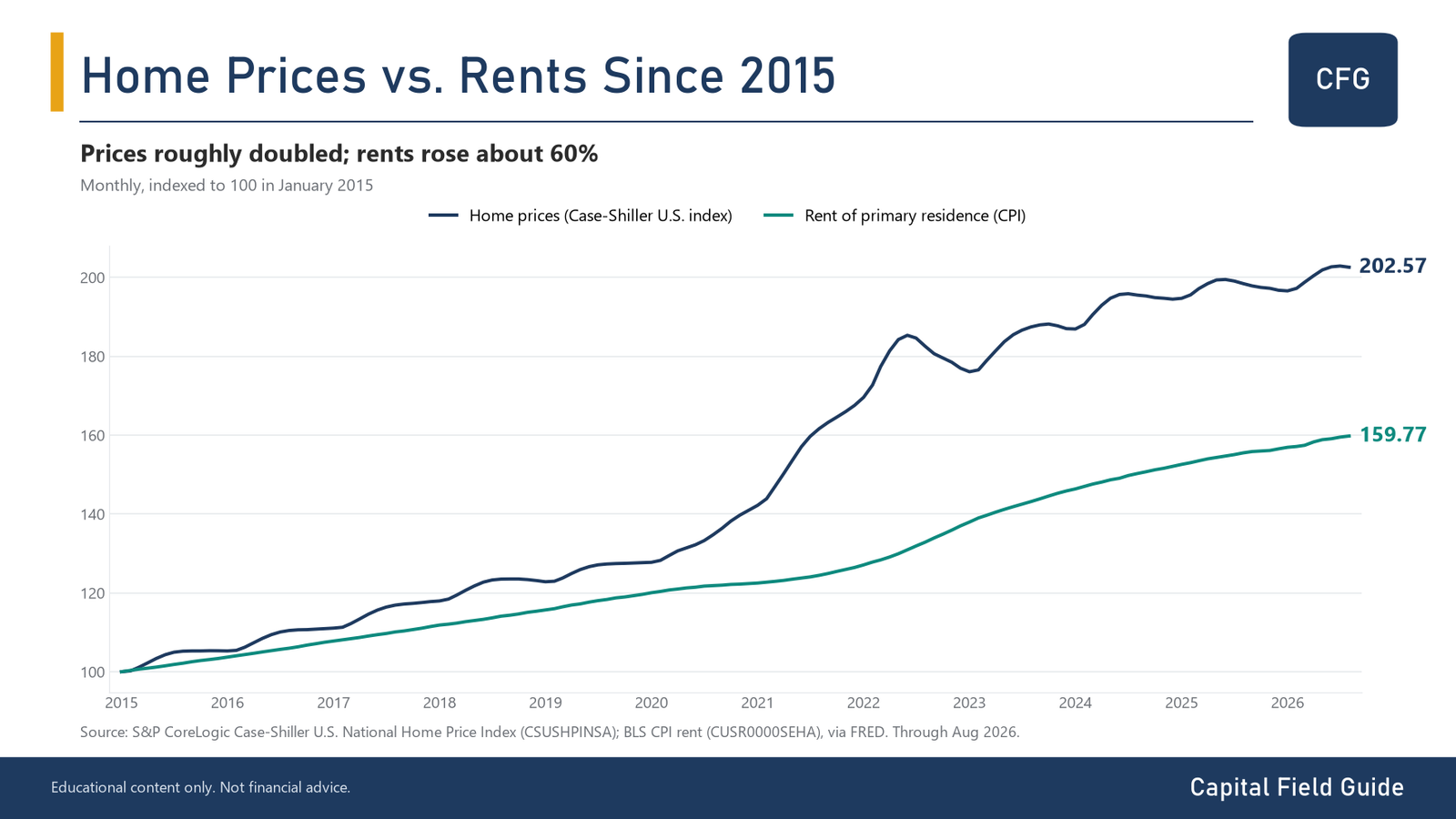
Since January 2015, home prices have roughly doubled. Rents rose about 60%.
When prices outrun rents, owning gets more expensive compared with renting the same kind of home. Economists call this the price-to-rent ratio, and when it’s high, the case for buying gets weaker.
In the past year the gap has narrowed a little, with rents up 2.8% and home prices up 2.1%. But a decade of separation doesn’t close in a year.
The cost nobody puts on the list
Most people compare rent with a mortgage payment. That misses the biggest cost of owning outright: the money tied up in the house isn’t earning anything.
Here’s an example. Say you own a $400,000 home free and clear:
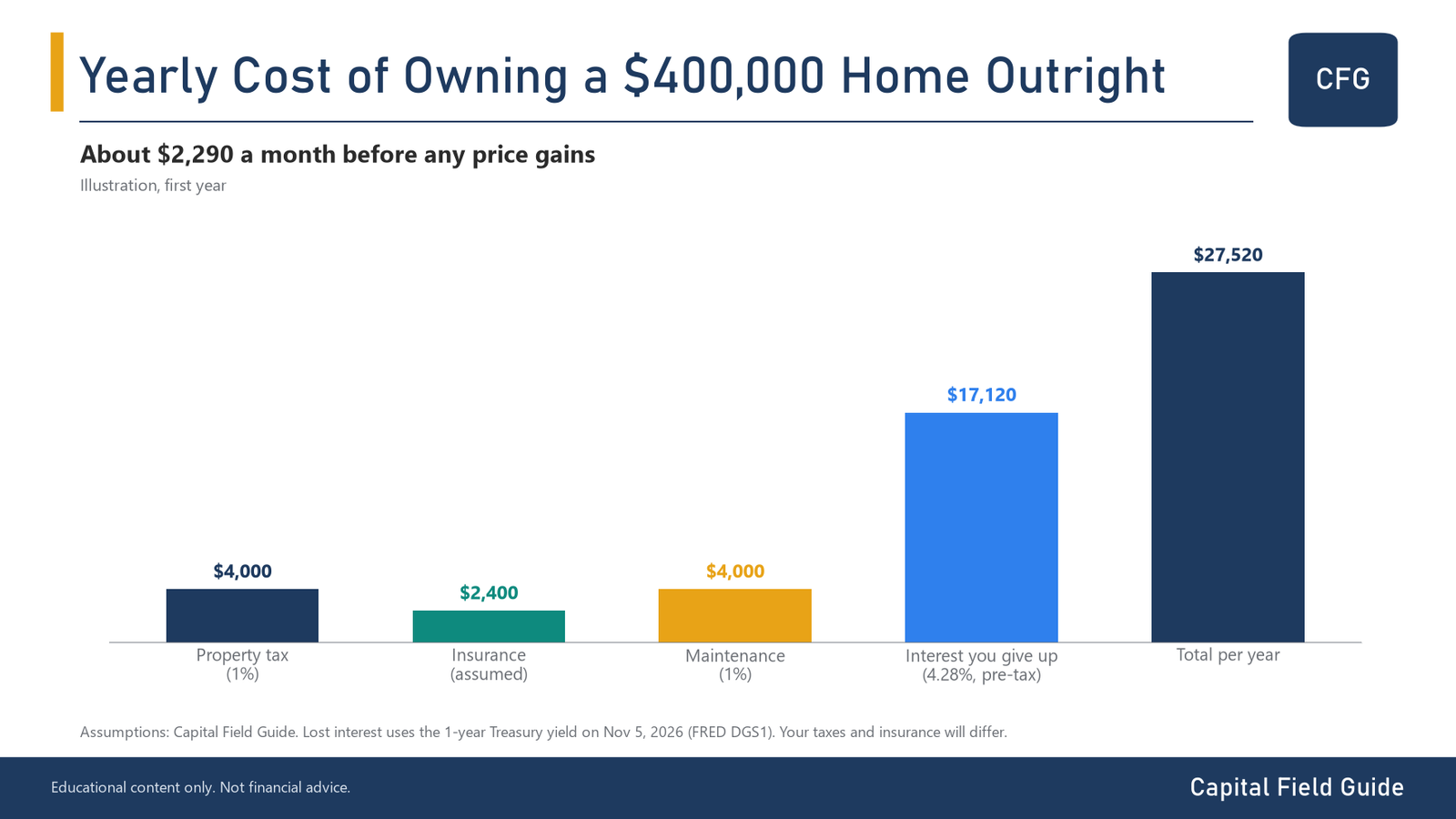
The math:
- Property tax at 1%: $4,000 (actual rates vary widely by state and county)
- Insurance (our assumption): $2,400
- Maintenance at 1% of value: $4,000
- Interest you give up: $400,000 × 4.28% = $17,120 before tax
Total: $27,520 a year, or about $2,293 a month. Treasury interest is taxable at the federal level, so on an after-tax basis the true cost of the lost interest is somewhat lower.
That’s the rent level where owning and renting roughly break even in year one, before any change in the home’s value. If prices rise 2% in a year, that’s $8,000 in your favor, and your break-even rent drops to about $1,627 a month. If prices fall, it goes the other way.
With a mortgage the picture is harder. Put 20% down and borrow $320,000 at 7.18%, and the principal-and-interest payment is about $2,168 a month. In the first year, about $22,874 of what you pay is interest and only about $3,139 goes to principal.
The cost of moving in and out
Buying and selling a house is expensive, and those costs matter most when you won’t stay long.
Freddie Mac estimates that buyers’ closing costs usually run 2% to 5% of the purchase price. Selling costs, mostly agent commissions, often add several percent more.
On a $400,000 home, 2% to 5% to buy plus, say, 5% to 6% to sell works out to roughly $28,000 to $44,000 for the round trip. Spread over 20 years, that’s minor. Spread over four years, it can wipe out any advantage of owning.
That’s the honest question for anyone over 60: how long will you really live in this house? Health, family and the need for care can force a move on someone else’s schedule.
What renting doesn’t solve
Renting isn’t free of risk. It just has different ones.
Rents rose about 51% over the 10 years through September 2026, according to the CPI. A homeowner with a paid-off house is protected from that. A renter isn’t.
Renters can also face a sale of the building or a non-renewal at the worst possible time. And many states offer property tax breaks or freezes for older homeowners, which can make staying put cheaper than our 1% assumption.
Owning also brings two tax advantages that matter more as you get older:
- The home sale exclusion. If you’ve owned and lived in the home for at least two of the last five years, you can generally exclude up to $250,000 of gain from tax ($500,000 for married couples filing jointly). Those amounts haven’t been raised since 1997, so long-time owners in expensive areas can go over them.
- The step-up at death. Heirs who inherit a home generally get a cost basis equal to its value when you die, which can erase decades of taxable gain.
Selling to rent means using the first benefit and giving up the second.
History check: timing still matters
Older buyers learned this the hard way once before.
The Case-Shiller national index, as it’s calculated today, peaked in July 2006 and fell about 27% by February 2012. Someone who bought at the top and needed to sell for health reasons a few years later took a real loss, sometimes on top of commissions.
High rates have come and gone too. The 30-year mortgage rate peaked at 18.63% in October 1981, and home buying didn’t stop. Many people who bought then were later able to refinance as rates fell.
The lesson isn’t that buying is bad. It’s that a short holding period can turn a normal market dip into a locked-in loss.
Our read: what we’d watch
Our read
This is our opinion, not a forecast.
If mortgage rates stay above 7% and Treasuries keep paying around 4%, we think renting will keep looking reasonable for people over 60 who expect to move within five to seven years, especially in places where local prices have run further ahead of rents than the national averages above.
If rates fall sharply, the math tilts back toward buying, though falling rates could also push prices up. And for retirees who already own a paid-off home they plan to stay in, the case for selling just to rent is usually weak once you count transaction costs and the lost step-up for heirs.
A simple way to run your own numbers
What you can do this week
1. Add up your true yearly cost of owning. Property tax, insurance, HOA fees, average repairs, plus your home equity multiplied by a safe yield such as the 1-year Treasury rate.
2. Price a real rental. Look up actual listings for a comparable home in the area you’d live in. Don’t use averages.
3. Be honest about your time horizon. If there’s a real chance you’ll move within five years, put buying and selling costs into the math.
4. Check the tax side before you sell. Estimate your gain against the $250,000 or $500,000 exclusion. Some homeowners talk with a tax professional first, especially if heirs are part of the plan.
FAQ
Is it a mistake to buy a home after 60?
Not necessarily. Owning can make sense if you plan to stay for many years and the cost of owning is close to local rents. It’s riskier if you may need to move soon.
Should I sell my paid-off house and rent?
It depends on your local rents, your taxes, your health and your heirs. Selling triggers transaction costs and gives up the step-up in basis your heirs could get.
What’s a good rule of thumb for comparing?
Multiply the home’s value by the sum of your property tax rate, upkeep rate and opportunity cost rate, add your yearly insurance and HOA costs, then divide by 12. If comparable rent is much lower than that, renting may be cheaper in the short run.
Can I avoid tax when I sell my home?
Many people can exclude up to $250,000 of gain, or $500,000 if married filing jointly, if they meet the ownership and use tests. IRS Publication 523 explains the rules.
The bottom line
After 60, a house is two things: a place to live and a large, idle pile of money.
Renting can free that money and your schedule. Owning can protect you from rent increases and give your heirs a tax break. Neither is automatically right.
The best house decision at 62 isn’t the cheapest one. It’s the one you won’t have to undo at 66.
Further reading: Is the Housing Market Finally Cracking? What the Data Says (and What It Doesn’t)
Sources
– Freddie Mac, Primary Mortgage Market Survey, 30-year fixed rate (MORTGAGE30US) via FRED (accessed Nov 10, 2026)
– U.S. Treasury, 1-year Treasury constant maturity (DGS1) via FRED
– S&P CoreLogic Case-Shiller, U.S. National Home Price Index (CSUSHPINSA) via FRED
– Bureau of Labor Statistics, CPI rent of primary residence (CUSR0000SEHA) via FRED
– IRS, Publication 523, Selling Your Home
– IRS, Topic 703, Basis of assets and Internal Revenue Code sec. 1014 (basis of inherited property)
– Freddie Mac, Budgeting for upfront homebuying costs
Rates and rules change. Check current figures before making decisions.
Disclaimer: This content is for general information and education only. It is not a recommendation to buy or sell any security, and it does not consider your personal financial situation. Investing involves risk, including possible loss of principal. You are responsible for your own financial decisions. Capital Field Guide and its authors are not liable for any losses or damages arising from the use of this information. Consider consulting a licensed financial, tax, or legal professional before acting.