This article is for educational purposes only and is not investment, tax, or financial advice. Read our Disclaimer.
Last reviewed: November 10, 2026. Sources are listed at the end.
How much can I spend without running out?
It’s the question behind almost every retirement worry. And the most common answer, “4% a year,” came from one financial planner’s spreadsheet in 1994.
Here’s the twist most people miss. The research says the bigger risk for many retirees isn’t spending too much. It’s spending so little that the money outlives them by decades.
Key takeaway
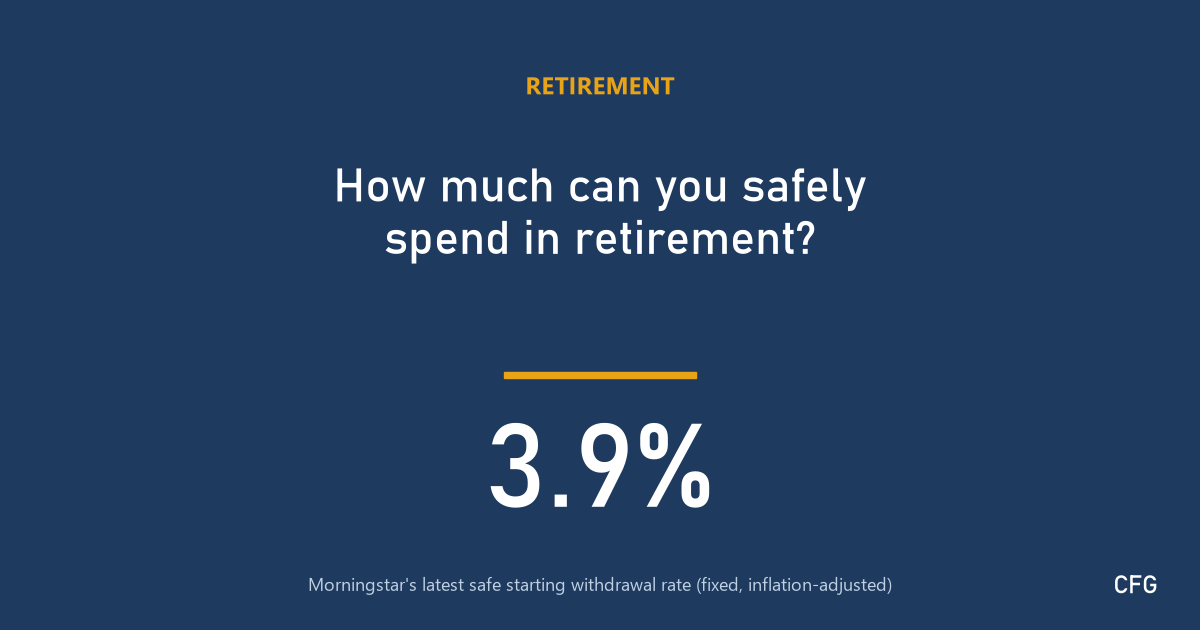
Morningstar’s latest research puts a safe fixed starting withdrawal at 3.9% of savings, adjusted for inflation each year after that. Retirees willing to cut back in bad years can often start higher; Morningstar’s flexible methods reached about 5.7%. Your number depends on your mix of investments, how long you need the money, and how much flexibility you really have.
Key numbers
| Item | Figure |
|---|---|
| Original “4% rule” (Bengen, 1994) | 4% first year, then raised with inflation |
| Morningstar safe starting rate, latest study (Dec 2025) | 3.9% (prior study: 3.7%) |
| Morningstar, flexible spending methods (upper end) | About 5.7% |
| Bengen’s updated worst-case rate (2025 book) | 4.7% |
| 10-year TIPS real yield (Nov 6, 2026) | 2.63% |
| First RMD as a share of the account | About 3.8% at 73 (1 ÷ 26.5); about 4.1% at 75 (1 ÷ 24.6) if born in 1960 or later |
Sources: Morningstar; W. Bengen; Federal Reserve via FRED; IRS Publication 590-B.

Where the 4% rule came from
In 1994, financial planner William Bengen tested historical U.S. stock and bond returns going back to 1926. He asked one question: what’s the highest first-year withdrawal that never ran out of money over 30 years, even for someone who retired at the worst possible moment?
The answer was about 4%. Take $40,000 from a $1 million portfolio in year one, raise it with inflation every year after, and history said you’d make it.
A 1998 study by three Trinity University professors reached a similar conclusion, and “the 4% rule” stuck.
Notice what it is, though. It’s a worst-case number. In most historical periods, a retiree could have spent much more and still died with money left over.
Today’s number: 3.9%, give or take
Every year Morningstar runs forward-looking projections instead of relying only on history. Its latest study, published in December 2025, puts the safe starting rate at 3.9%, assuming a 30-year retirement, inflation-adjusted withdrawals, and a 90% chance of not running out. The study before that said 3.7%.
Bengen himself went the other direction. In his 2025 book, he raised his own worst-case figure to 4.7%, using a more diversified portfolio than his original stock-and-bond mix.
Here’s what those differences mean in actual dollars:
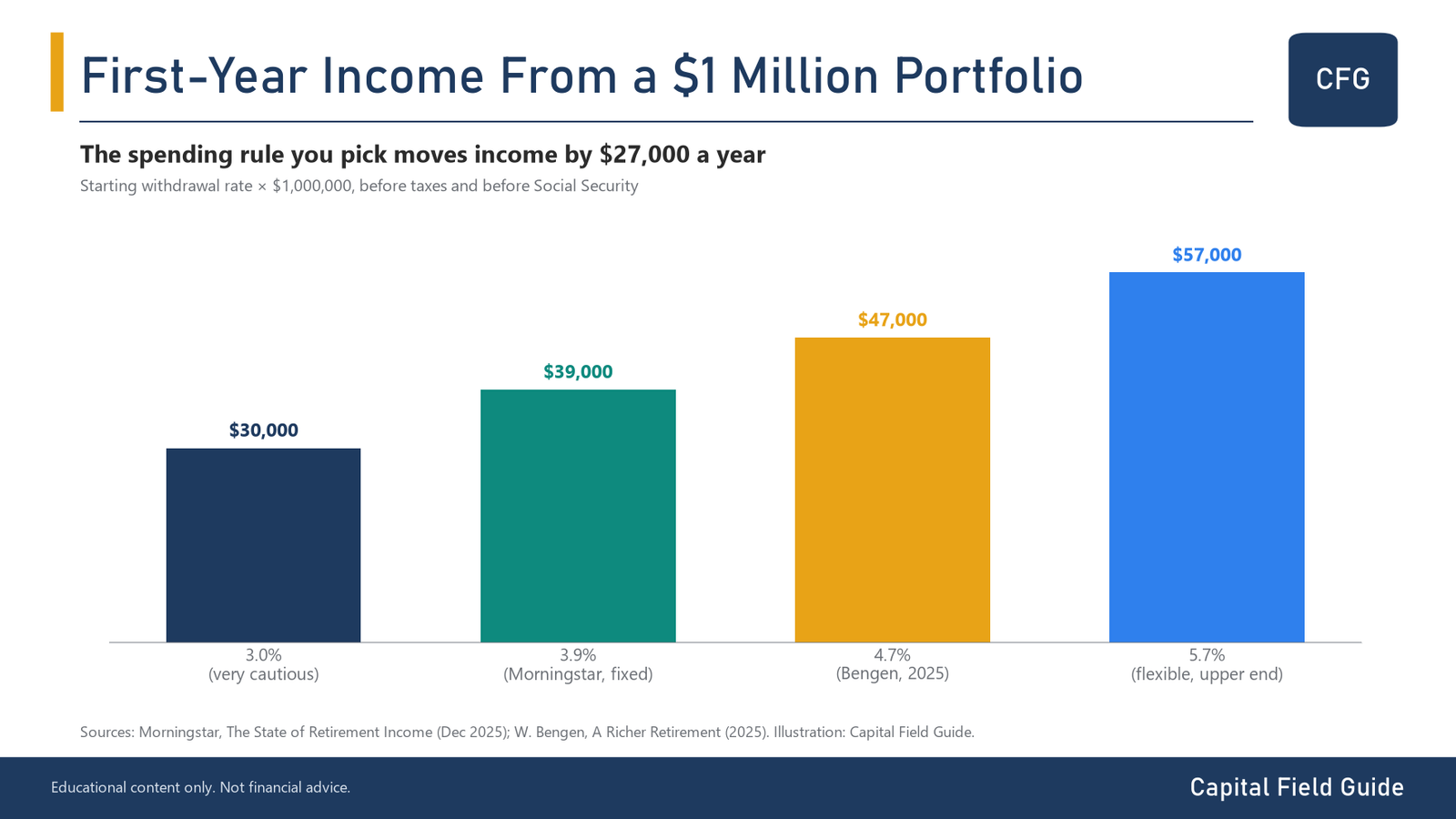
That’s a $27,000-a-year gap between a very cautious 3% (our own illustration, not a published rule) and the upper end of Morningstar’s flexible methods. Over a 30-year retirement, the choice of rule matters more than most fund fees ever will.
Why the safe rate moves around
Two things drive it: how expensive stocks are when you retire, and how much bonds pay.
When stocks are priced high, future returns tend to be lower, which pulls the safe rate down. When bonds pay more, it pushes the rate up.
The bond side has changed a lot. Here’s the real yield, meaning the return above inflation, on 10-year Treasury Inflation-Protected Securities:
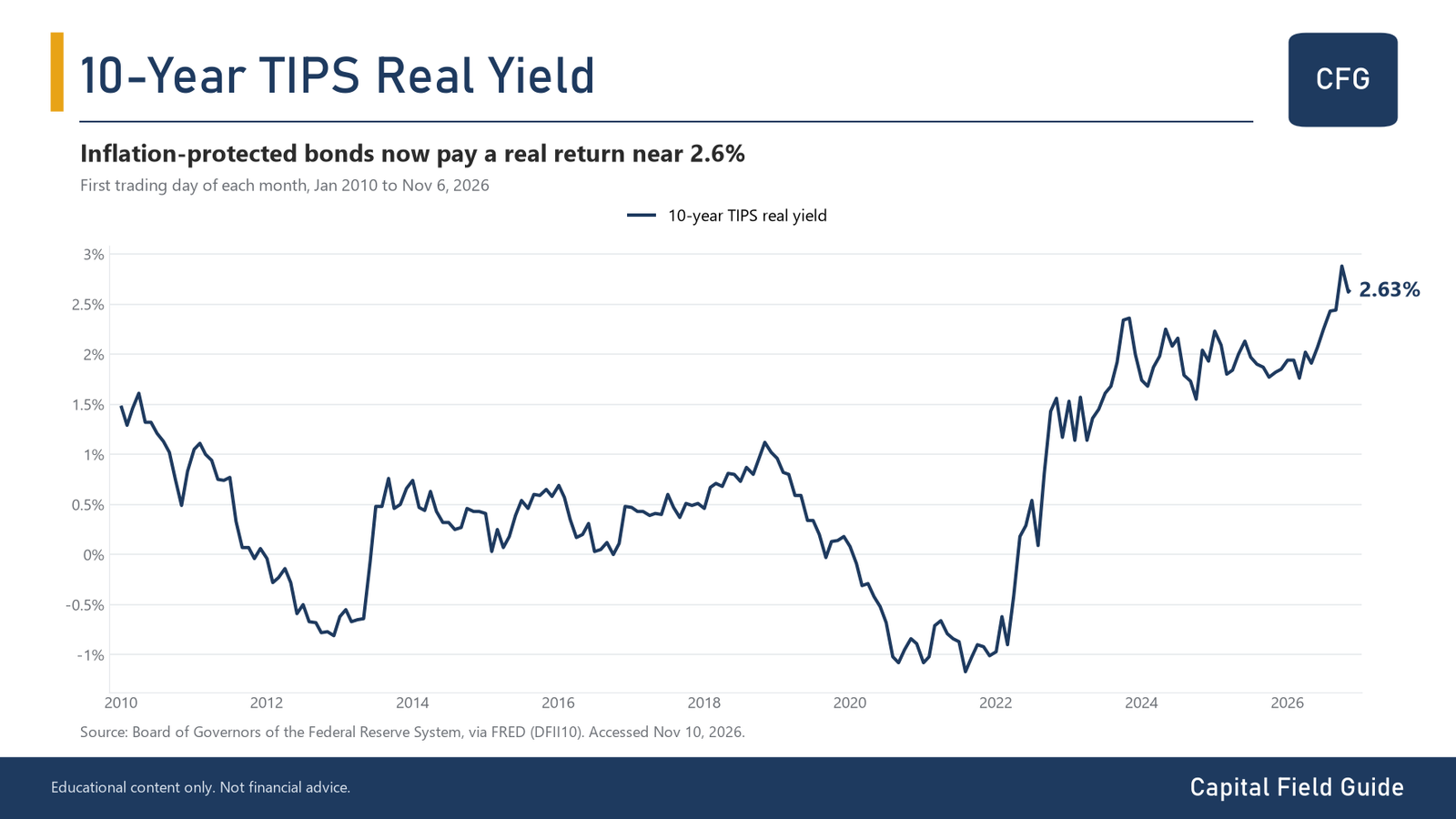
In 2021, TIPS paid less than inflation. Today they pay about 2.6% more than inflation.
That matters because a TIPS ladder held to maturity can now lock in a lot of inflation-adjusted income with very little market risk.
As a rough illustration, if every rung of a 30-year TIPS ladder paid a 2.6% real yield, it could fund about 4.8% of the starting balance each year, rising with inflation, until the money runs out at year 30. Real ladders use bonds with different yields, so actual results vary.
The trade-off: a ladder is designed to spend down to zero. It doesn’t leave a cushion if you live past 95.
The surprising problem: retirees who won’t spend
Here’s where the fear and the data part ways.
The Employee Benefit Research Institute tracked retirees’ assets using a long-running national survey. Among people who retired with at least $500,000, the typical household had spent only about 11.8% of its savings roughly two decades into retirement. Across all the retirees EBRI studied, about a third saw their assets grow over roughly the first 18 years.
Some of that is healthy caution. Health care costs and long lives are real risks. But some of it is people denying themselves trips, help around the house, or gifts to family they could easily afford.

History check: when the safe rate actually got tested
The 4% rule was built around the retirees who had it worst. In Bengen’s original data, that was the class of the mid-to-late 1960s: a weak stock market followed by the inflation of the 1970s squeezed them from both sides.
Retirees who started in 2000 faced a similar test, with two bear markets in their first decade. Studies of that group are why planners talk so much about sequence of returns risk. Bad years early in retirement do far more damage than the same bad years later, because you’re selling investments while they’re down to pay the bills.
That’s also why “flexible” strategies work. In 2006, financial planner Jonathan Guyton and William Klinger published “guardrails” rules: spend more when your portfolio does well, trim spending when it falls too far. A small cut in a bad year protects the portfolio when it’s most vulnerable.
Our read: what we’d watch
Our read
This is our opinion, not a promise about markets.
If real yields stay near today’s levels, we think new retirees have more good options than they’ve had in 15 years, especially for covering basic expenses with TIPS, Social Security and other guaranteed income. If yields fall back toward zero, the safe rate for bond-heavy retirees would likely drift lower again, as it did after 2020.
The bigger risk we see is stock valuations. Stocks have been priced well above long-term averages for much of this decade, and history suggests high starting prices have tended to lead to lower long-run returns. We think that’s a big reason Morningstar’s fixed rate still sits below 4% even with better bond yields.
The case against our view is fair: valuations have been “high” for years while stocks kept climbing, and anyone who cut spending on that worry alone left money on the table. That’s exactly why we lean toward flexible spending rules over a single fixed number.
What you can do this month
Practical steps
1. Separate needs from wants. Add up your basic yearly expenses, then subtract Social Security and any pension. What’s left is the amount your savings must reliably cover.
2. Run your own rate. Divide what you plan to withdraw by your total savings. Anything near 4% is in the range most research supports for a 30-year retirement; well above that usually calls for flexibility or a shorter horizon.
3. Decide your “bad year” plan now. Some retirees write down in advance how much they’d trim, such as 10%, if the portfolio drops by a set amount. It’s easier to follow a rule you made when calm.
4. Look at the RMD as a floor check. Required minimum distributions start at 73 if you were born from 1951 through 1959, and at 75 if you were born in 1960 or later. The first one is about 3.8% of the account at 73, or about 4.1% at 75, and it rises each year. Some retirees use them as a rough spending guide, though they’re a tax rule, not a spending plan.
5. Check your Social Security timing. Waiting past full retirement age raises your benefit by 8% a year until 70, which can lower how much you need to draw from savings.
FAQ
Is the 4% rule still valid?
As a starting point, roughly. The latest research ranges from about 3.9% for fixed, inflation-adjusted spending to about 4.7% in Bengen’s updated work, and higher for people willing to adjust.
Does the 4% include Social Security?
No. The rate applies only to your savings. Social Security and pensions come on top.
What if I retire at 60 instead of 65?
A longer retirement generally means a lower safe rate, because the money has to last more years. Morningstar’s estimates assume 30 years.
Should I spend less if the market just dropped?
That’s what flexible “guardrail” strategies do. A modest cut in a down year can protect the portfolio, though it means accepting some income swings.
The bottom line
There’s no single safe number. There’s a range, roughly 3.9% to 5% for most people, and where you land depends on your investments, your health, your other income, and your willingness to bend.
The 4% rule was never a speed limit. It was a guardrail built for the worst stretch in modern market history.
Saving was the hard part. Spending it wisely, without fear doing the steering, is the part worth planning.
Further reading: Social Security’s 3.6% Raise for 2027: What Actually Lands in Your Bank Account
Sources
– W. P. Bengen, “Determining Withdrawal Rates Using Historical Data,” Journal of Financial Planning (Oct 1994)
– P. Cooley, C. Hubbard, D. Walz, “Retirement Savings: Choosing a Withdrawal Rate That Is Sustainable,” AAII Journal (Feb 1998)
– Morningstar, The State of Retirement Income (Dec 2025)
– Advisor Perspectives, Bill Bengen Boosts the “4% rule” to 4.7% (Aug 29, 2025)
– EBRI, Asset Decumulation or Asset Preservation? What Guides Retirement Spending? (Issue Brief no. 447, April 2018)
– Board of Governors of the Federal Reserve System, 10-year TIPS yield, FRED series DFII10 (accessed Nov 10, 2026)
– IRS, Publication 590-B (Uniform Lifetime Table)
– Social Security Administration, Delayed retirement credits
– J. Guyton and W. Klinger, “Decision Rules and Maximum Initial Withdrawal Rates,” Journal of Financial Planning (March 2006)
Rules and research change. Past performance doesn’t guarantee future results.
Disclaimer: This content is for general information and education only. It is not a recommendation to buy or sell any security, and it does not consider your personal financial situation. Investing involves risk, including possible loss of principal. You are responsible for your own investment decisions. Capital Field Guide and its authors are not liable for any losses or damages arising from the use of this information. Consider consulting a licensed financial, tax, or legal professional before acting.