This article is for educational purposes only and is not investment, tax, or legal advice. Read our Disclaimer.
Last reviewed: November 23, 2026. Sources are listed at the end.
You’ve heard that a will sends your family to court for a year and a trust avoids all of it. You’ve also heard a trust costs thousands, and you can’t tell whether you need one.
This post puts a dollar figure on probate, shows what a living trust does and doesn’t do, and lists the cheaper tools that often do the same job.
We worked from state statutes and federal law on November 23, 2026. Use this as a map for a conversation with an estate attorney in your state.
Key takeaway
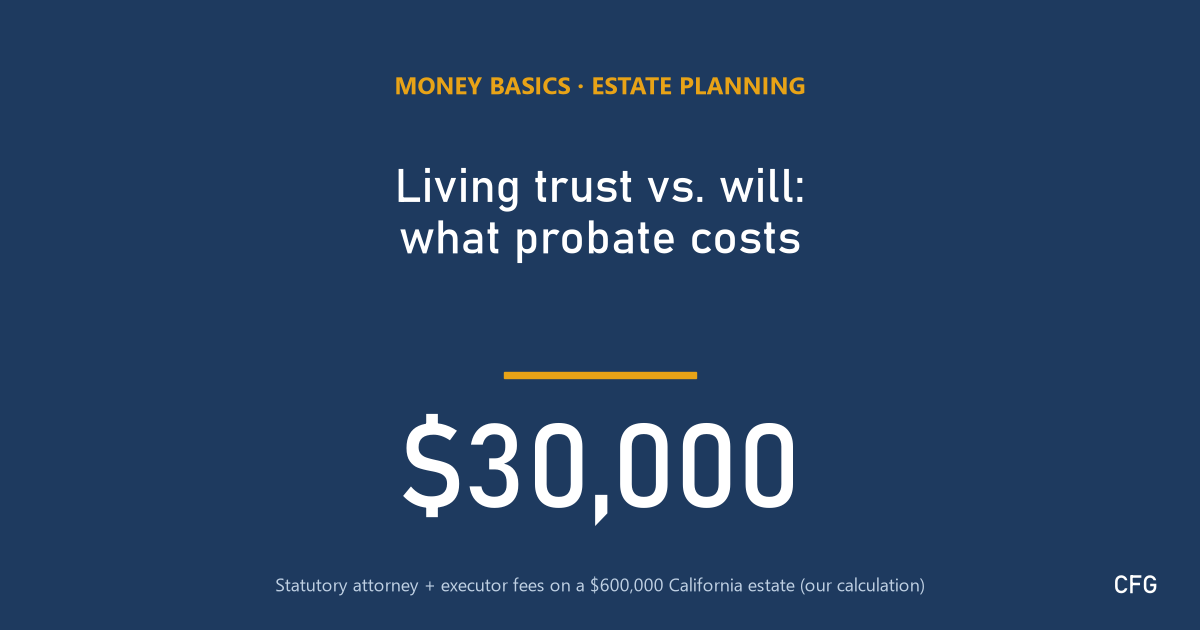
A revocable living trust can avoid probate, but only for assets actually retitled into it. It doesn’t lower income tax or estate tax for most people, and generally it doesn’t protect assets from Medicaid or from your creditors while you’re alive. In California, the statutory attorney fee on a $600,000 estate is $15,000, and the executor’s statutory fee is another $15,000.
Many other states use hourly or “reasonable fee” rules, so the bill can be smaller or larger.
Key numbers
| Item | Figure | Source |
|---|---|---|
| California statutory fee, each for attorney and executor | 4% of first $100,000, 3% of next $100,000, 2% of next $800,000 | Prob. Code §§10800, 10810 |
| Both fees on a $600,000 California estate | $15,000 + $15,000 = $30,000 | Our calculation |
| California small estate limit, deaths on or after April 1, 2025 | $208,850 | Judicial Council of California |
| Federal estate tax exemption 2026 / 2027 | $15,000,000 / $15,480,000 | IRS |
| Revocable trust assets, Medicaid | Count as available to you | 42 U.S.C. §1396p(d) |
Sources: California Probate Code §§10800, 10810, 13100; Judicial Council adjusted amounts table; IRS IR-2026-133; Cornell LII (accessed Nov 23, 2026).

What does probate actually cost?
It depends on your state.
California is one of the costlier cases because its Probate Code sets fees by formula. Under §10810, the attorney’s fee is 4% of the first $100,000, 3% of the next $100,000, and 2% of the next $800,000. The executor’s fee under §10800 uses the same schedule.
We read both sections on the state’s legislative site on November 23, 2026. The fee is figured “without reference to encumbrances,” so a mortgage doesn’t reduce the number.
Here’s a hypothetical with round numbers: a $600,000 California estate.
| Tier | Math | Fee |
|---|---|---|
| First $100,000 | $100,000 x 4% | $4,000 |
| Next $100,000 | $100,000 x 3% | $3,000 |
| Next $400,000 | $400,000 x 2% | $8,000 |
| Attorney total | $15,000 | |
| Executor total | same schedule | $15,000 |
That’s $30,000, or 5% of the estate, before court costs, appraisals and any extra fees a judge approves for unusual work.
Here’s how the fee grows with estate size:
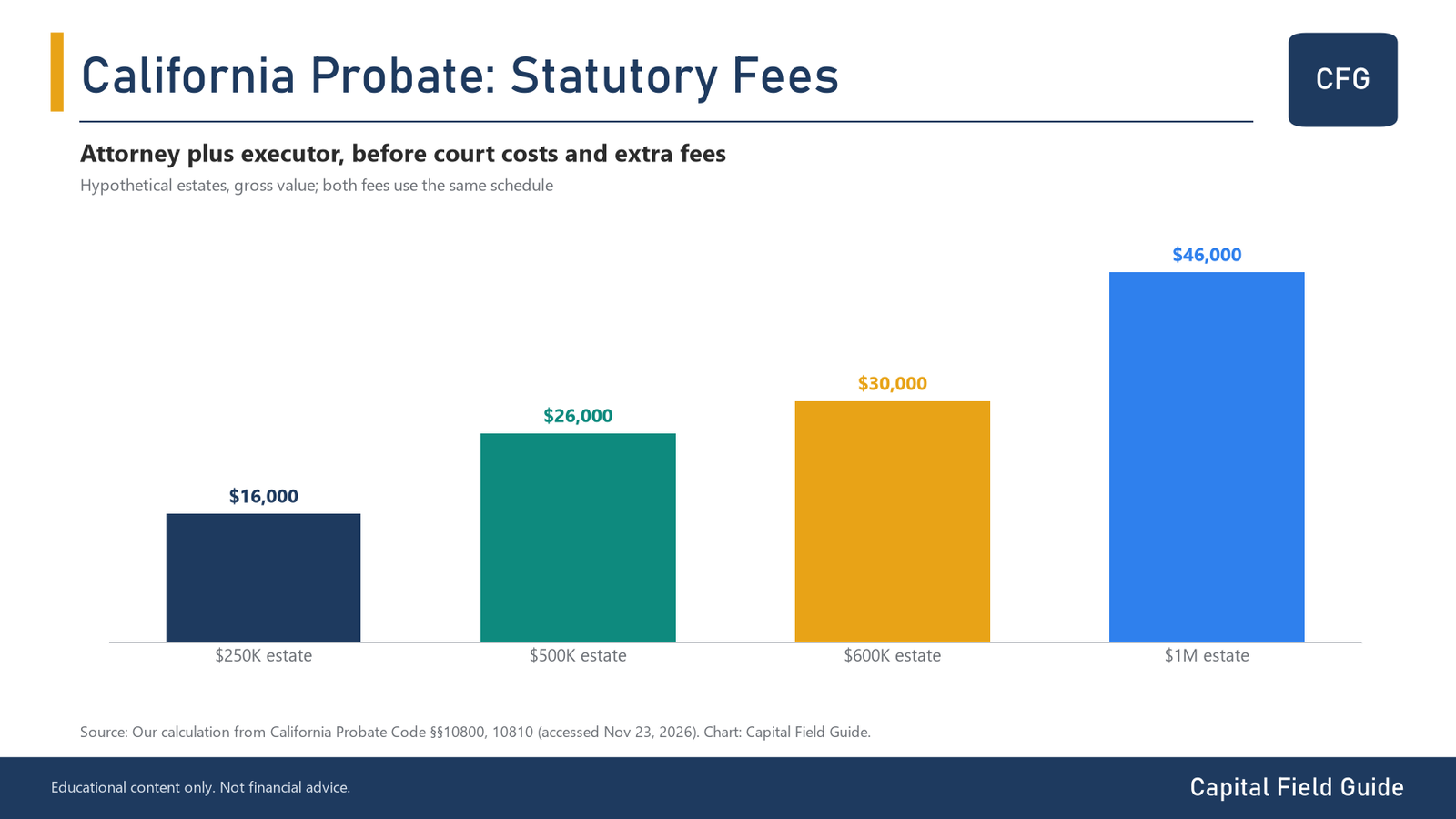
Source: Our calculation from California Probate Code §§10800 and 10810. Hypothetical estates, gross value. Chart: Capital Field Guide.
How long does it take? There’s no national number. Simple estates can close in months, while disputes, real estate in several states or missing paperwork can stretch things out much longer.
What does a living trust cost?
Usually more upfront than a simple will. Fees vary by state and by how complicated your assets are, and we won’t quote a price we couldn’t source. Ask for a flat fee in writing, including who handles retitling your house and accounts.
A trust isn’t free to run at death either, since the successor trustee still has work to do. The savings come from skipping court filings and, in some states, statutory fees.
What does a living trust not do?
It doesn’t cut your taxes. A revocable trust is generally treated as yours for income tax. Its assets are still in your estate for federal estate tax under 26 U.S.C. §2038. Only estates above the exemption, $15,000,000 in 2026 and $15,480,000 in 2027, owe federal estate tax at all.
Some states have their own estate or inheritance taxes, so ask about yours.
A trust-held house can still get the date-of-death basis step-up, the same as a house held outright. We covered that math in the post linked below.
It generally doesn’t protect you from Medicaid. Under 42 U.S.C. §1396p(d), the assets of a revocable trust you set up count as resources available to you. Only an irrevocable structure, with the five-year look-back and loss of control that come with it, is a different conversation.
It generally doesn’t shield assets from your creditors while you’re alive. If you can take the money back, a creditor can generally reach it. The Uniform Trust Code, adopted in many states, says revocable trust property is subject to the settlor’s creditors during the settlor’s lifetime. State versions vary.
It doesn’t work if you don’t fund it.
What’s the #1 mistake with a living trust?
Signing the trust and never retitling anything into it.
A trust governs only what it owns. If the deed to your house, your bank accounts and your brokerage account still say your name alone, those assets can still go through probate. People often pay for the document and skip the paperwork.
Funding generally means:
- A new deed for real estate, recorded in the right county
- Retitling bank and brokerage accounts, or adding the trust as a beneficiary where allowed
- Naming the trust on new accounts you open later
A pour-over will is the backup. It says anything you forgot to put in the trust goes to it at death. It’s still a will, so assets it catches still go through probate.
Most people who have a trust also keep a pour-over will.

Which cheaper tools skip probate too?
Many assets pass outside probate with a form, not a trust. They also override your will, so keep them current.
- Beneficiary designations on IRAs, 401(k)s, annuities and life insurance. The named person gets the money directly.
- POD and TOD registrations on bank and brokerage accounts. You keep control while alive.
- TOD deeds for real estate. The National Consumer Law Center counted 35 states plus D.C. with TOD deed laws in 2026. Other counts differ slightly, so check your own state.
- Small-estate affidavits. Many states let heirs collect small estates with a sworn form instead of a full probate case. Dollar limits vary widely. California’s is $208,850 for deaths on or after April 1, 2025, and the state’s court self-help site says the next adjustment comes April 1, 2028.
- Joint ownership. It’s simple, but it gives the other owner rights now and can backfire after a divorce or a lawsuit.
If most of what you own already has a named beneficiary, probate may have little left to touch.
Who tends to benefit more from a trust?
A trust tends to earn its cost when probate is complicated, slow or public:
- You own real estate in more than one state, which can mean a separate probate case in each
- You want privacy, since wills filed with a court are generally public and trusts generally aren’t
- You want a named person to manage your money if you become incapacitated
- You have a blended family, a minor or a special-needs heir who needs controlled payouts
- You live in a state with high probate costs, such as California
A will plus current beneficiary designations may be enough when your estate is modest, your assets are mostly accounts with named beneficiaries, and your state offers a simple small-estate process.
One gap either way: a will, a TOD deed and beneficiary forms do nothing while you’re alive. A durable power of attorney and a health care directive are the documents that cover incapacity.
Our read: what we’d watch
Our read
This is our opinion, not legal or tax advice.
If you own a home in a high-cost probate state, a trust can pay for itself, as long as it’s funded.
If your main assets are retirement accounts and a paid-off house in a state with a TOD deed, forms may handle probate for far less. They won’t manage your money if you become incapacitated, so some people pair them with a power of attorney.
If you’re counting on a trust to cut taxes or shield you from long-term care costs, the law generally doesn’t deliver that for a revocable trust.
Here’s what we’d watch: whether the house is retitled, whether beneficiary forms match your wishes, and what your state charges for probate.
What some people do first
Practical steps
1. Listing every asset and how it’s titled. Some people write down each account, who is named as beneficiary, and whose name is on the deed.
2. Pricing probate in their own state. Many check the state court’s website or ask an estate attorney what probate would cost.
3. Updating forms before buying documents. Some fix old beneficiary designations first, since those override a will.
4. Asking about funding. People who choose a trust often ask who retitles the house and accounts, and whether that’s in the fee.
FAQ
Do I still need a will if I have a trust?
Usually yes. A pour-over will catches assets you didn’t retitle, and it’s also where many people name guardians for minor children.
Is a TOD deed better than a trust for my house?
It can be simpler and cheaper where your state allows it. A trust handles incapacity and more complex wishes. Both have trade-offs worth discussing with a lawyer.
Will probate take a year?
Some do and many don’t. Time depends on your state, creditor deadlines, disputes and how clean the paperwork is.
Does a trust protect my home from nursing-home costs?
A revocable one generally doesn’t. Medicaid counts it as yours.
The bottom line
A living trust doesn’t cut your taxes or beat Medicaid. It moves your property out of probate court, and only if you retitle it.
For some families, beneficiary forms and a will do that for less. For others, a funded trust can be worth the cost.
A trust you never fund buys you very little.
Further reading: Should You Put Your House in Your Kids’ Names? The Capital Gains Trap, the Gift Tax Form and Safer Options
Sources
– California Legislative Information, Probate Code §10810, attorney compensation and §10800, personal representative compensation
– California Legislative Information, Probate Code §13100, small estate affidavit
– Judicial Council of California, Probate Code §890 adjusted amounts and California Courts Self-Help, Check if you can use a simple process to transfer property
– Maine Revised Statutes, 18-B §505, Creditor’s claim against settlor (one state’s version of Uniform Trust Code §505)
– Cornell LII, 26 U.S.C. §2038, Revocable transfers
– Cornell LII, 42 U.S.C. §1396p, Liens, adjustments and recoveries, and transfers of assets
– IRS, Newsroom IR-2026-133, 2027 inflation adjustments and Rev. Proc. 2025-32
– National Consumer Law Center, Protecting the Family Home: TODDs (Aug 2026)
Rules and amounts can change. Check the sources and your state’s court website before acting.
Disclaimer: This content is for general information and education only. It is not a recommendation to buy or sell any security, and it does not consider your personal financial situation. Investing involves risk, including possible loss of principal. You are responsible for your own investment decisions. Capital Field Guide and its authors are not liable for any losses or damages arising from the use of this information. Consider consulting a licensed financial, tax, or legal professional before acting.