This article is for educational purposes only and is not investment, tax, or legal advice. Read our Disclaimer.
Last reviewed: November 22, 2026. Sources are listed at the end.
Retiring with a monthly mortgage payment feels like walking into winter without a coat. Paying it off feels like the cure. It can also lock your cash inside the walls of your house, and if the money comes from an IRA, hand the IRS a bill first.
This post runs the numbers for a $150,000 balance, then covers the tax and Medicare catches and the in-between options.
We checked the rate, tax and Medicare figures on official pages on November 22, 2026. Everything below is general education, and the dollar examples are our own illustrations.
Key takeaway
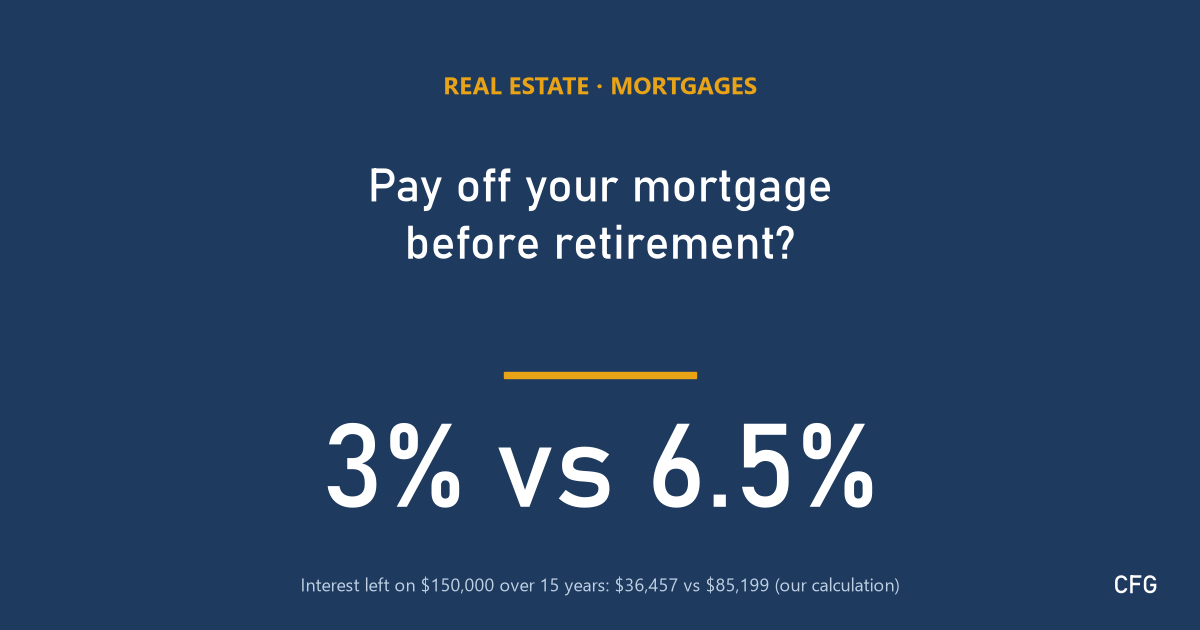
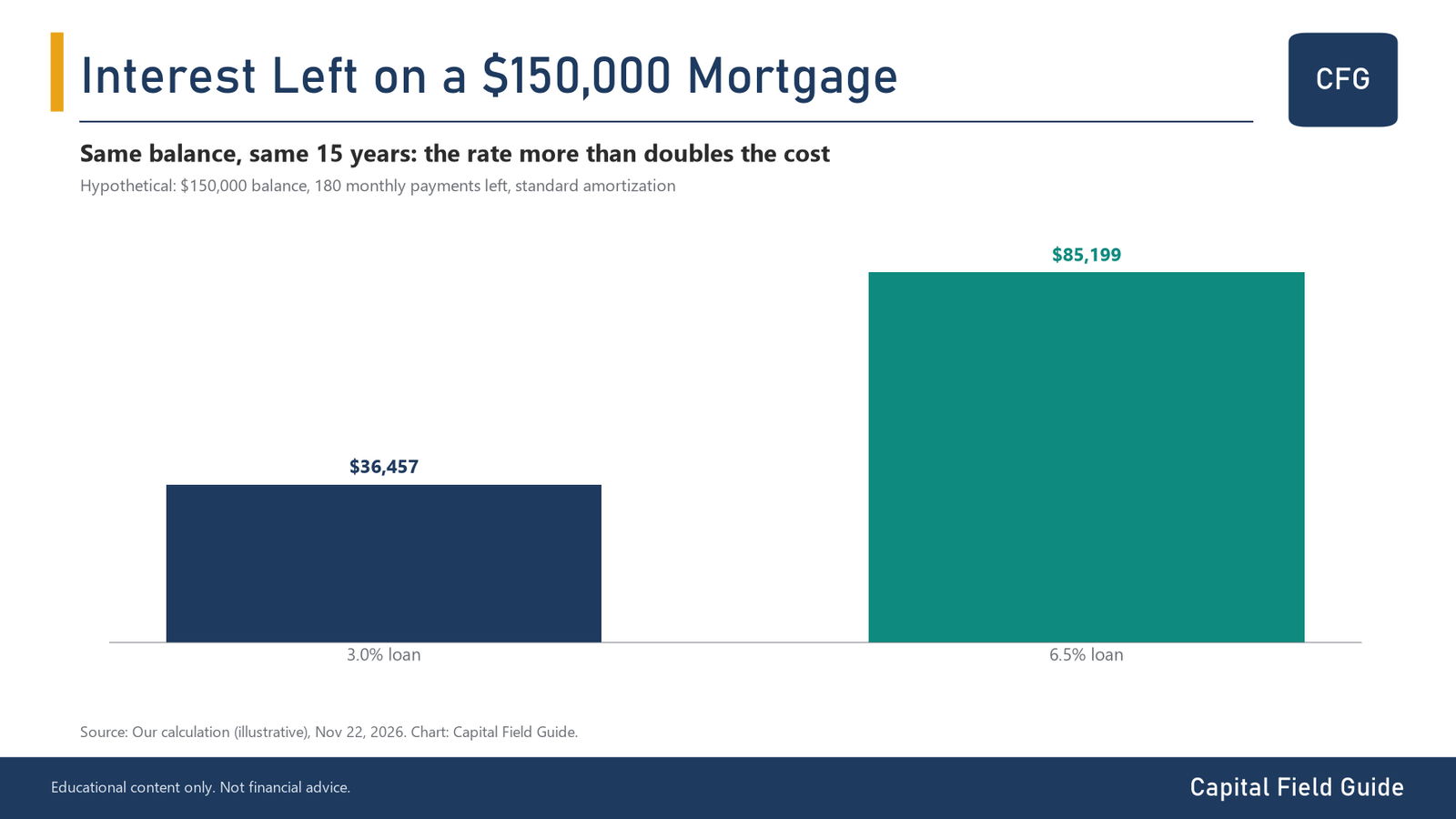
Paying off a mortgage is a guaranteed, after-tax return equal to your loan rate, and that return is where the decision starts. On a $150,000 balance with 15 years left, a 3.0% loan costs about $36,457 in remaining interest and a 6.5% loan about $85,199 (our calculation). Cash that could earn about 3.5% after tax in Treasuries slightly beats prepaying a 3% loan, but not a 6.5% one. Paying off with IRA money adds a tax bill, because roughly $192,000 must come out to net $150,000 at a flat 22% federal rate.
Key numbers
| Item | Figure | Source date |
|---|---|---|
| Freddie Mac 30-year fixed rate (week of) | 7.28% (7.11% prior week) | Nov 19, 2026 |
| Outstanding mortgages with rates below 4% / below 3% | 49.1% / 19.2% | FHFA NMDB, Q2 2026, by loan count |
| Homeowners 65-79 / 80+ with a mortgage (2022) | 41% / over 30% | Harvard JCHS, 2023 report |
| 10-year Treasury / 1-year Treasury yield | 4.92% / 4.51% | Treasury, Nov 20, 2026 |
| 2026 standard deduction: joint / single | $32,200 / $16,100 | IRS Rev. Proc. 2025-32 |
| Extra for age 65+ (2026): married each / single | $1,650 / $2,050 | IRS Rev. Proc. 2025-32 |
| Senior deduction, 2025-2028 | $6,000 per person | IRS |
| 2026 Medicare Part B standard premium | $202.90 a month | CMS |
Sources: Freddie Mac; FHFA National Mortgage Database; Harvard JCHS; U.S. Treasury; IRS; CMS (accessed Nov 22, 2026).

Why does a payoff feel safe but act like an investment?
Every extra dollar you send to a mortgage earns the loan’s interest rate, risk free, and you don’t owe tax on it. At 3.0% that’s a 3.0% return. At 6.5% it’s 6.5%.
That is the comparison to make. The question isn’t “debt bad, no debt good.” It’s whether your cash could earn more somewhere else after tax, and what you give up by locking it in a house.
Here is the math. A standard monthly payment is P x r / (1 – (1 + r)^-n), where P is the balance, r is the monthly rate and n is the months left. With $150,000 and 180 months left:
| 3.0% loan | 6.5% loan | |
|---|---|---|
| Monthly principal and interest | $1,035.87 | $1,306.66 |
| Total paid over 15 years | $186,457 | $235,199 |
| Interest remaining | $36,457 | $85,199 |
A 6.5% loan with 15 years left isn’t the typical 6.5% loan. Loans taken in the last few years near that rate mostly have 25 or more years left. With 28 years left, the same $150,000 costs $970.52 a month and $176,096 in remaining interest.
Here’s a chart of the 15-year example at each rate:
Source: Our calculation, illustrative. Standard amortization, $150,000 balance, 180 months. Chart: Capital Field Guide.
A 2.65% loan sits even further toward the cheap end: on the same $150,000 and 15 years, remaining interest is about $31,946. Freddie Mac’s 30-year average was 7.28% on November 19, 2026, which is why loans from the low-rate years are hard to replace, and the FHFA National Mortgage Database shows 49.1% of outstanding mortgages below 4% and 19.2% below 3% in Q2 2026, counted by number of loans.
What could the same cash earn instead?
The 10-year Treasury yielded 4.92% and the 1-year 4.51% on November 20, 2026. Treasury interest is taxable federally and exempt from state and local tax, so at a 22% federal rate, 4.5% is about 3.5% after tax.
Say you keep the $150,000 in Treasuries, earn 3.51% after tax, and pay the mortgage from that pile each month for 15 years:
- 3.0% loan: about $8,794 is left at the end. Keeping the cash came out slightly ahead.
- 6.5% loan: the pile runs out and you’d be about $55,241 short. Paying off came out far ahead.
A 4% yield instead would leave about $1,989 at 3.0%, still near break-even. This is an illustration, not a forecast: yields change, and a Treasury rolled over for 15 years won’t hold 4.5%.
Does the mortgage interest deduction save you anything?
Often not. Interest is deductible on the first $750,000 of debt (Publication 936), but only if you itemize. For 2026 the standard deduction is $32,200 for joint filers and $16,100 for single filers, plus $1,650 per spouse (or $2,050 if single and not a surviving spouse) for age 65+.
Year-one interest in our examples is about $4,390 at 3.0% and $9,570 at 6.5%, both well under $32,200. Paying the loan off may cost little or no deduction. Treasury interest, in contrast, is taxed.
What if the money comes from an IRA or 401(k)?
Traditional IRA and 401(k) withdrawals are ordinary income. To net $150,000 at a flat 22% federal rate, you’d withdraw $150,000 / 0.78, or about $192,308, and $42,308 goes to tax. At 24% it’s about $197,368. A withdrawal that large can push part of it into higher brackets, while a couple with little other income may pay a lower effective rate, so the real bill can be bigger or smaller.
Two side effects are worth knowing:
- Medicare surcharges (IRMAA). Medicare uses your tax return from two years earlier. For 2026 premiums, the 2024 return counts. Above $109,000 single or $218,000 joint, the 2026 Part B add-on starts at $81.20 a month per person, on top of $202.90.
- The senior deduction. The $6,000 deduction per person for 2025-2028 phases out above $75,000 of modified adjusted gross income ($150,000 joint), so a one-year spike can shrink it.

What does inflation do to a fixed payment?
A fixed-rate payment stays put while prices rise. In the Great Inflation (1965 to 1982), the Federal Reserve notes, year-over-year consumer price inflation peaked in March 1980 at close to 15%. A borrower with a fixed payment then repaid in cheaper dollars.
Inflation today is far below that 1980 peak, and there’s no promise history repeats. The principle is what matters: a low fixed rate is a hedge that a payoff gives up. A payoff also can’t be undone. Once the cash is in the house, getting it back means selling, borrowing at today’s rates or tapping a home equity loan, and a lender may be slower to approve a home equity line once your paycheck stops. That’s why some retirees keep a cash cushion even after a payoff.
Our read: what we’d watch
Our read
This is our opinion, not tax or financial advice.
If your rate is low (near 3% or below) and you have cash earning more after tax, the math has often favored keeping the loan, as long as the payment is easy to cover from reliable income.
If your rate is high (6% or above), a payoff is a strong guaranteed return, and it also removes a fixed bill (about $12,430 a year on the 3% example, $15,680 at 6.5%).
If the only way to pay it off is an IRA withdrawal, the tax, the Medicare look-back and the lost deduction can erase much of the gain. Spreading withdrawals across years, or paying off only part, changes that math.
If the payment keeps you up at night, peace of mind is a real number too. Some retirees accept a lower return to sleep better, and that’s a reasonable call.
Here’s what we’d watch: your rate, your after-tax cash yield, and how much liquid money you’d have left on the day after payoff.
What middle paths do some retirees consider?
- Partial prepayment. Extra principal each year shortens the loan without draining savings.
- A recast. Some lenders will re-amortize after a lump sum, lowering the payment while keeping the rate. Government-backed loans (FHA, VA, USDA) often can’t be recast, and fees, minimum lump sums and availability vary, so ask the servicer.
- Timing the payoff. Some retirees wait for a lower-income year, or until the loan is a few years from done, so withdrawals land in lower brackets.
Practical steps
1. Knowing the real rate and payoff. Some homeowners request a payoff quote and check the rate, balance and months left.
2. Running the after-tax comparison. Many compare their loan rate with what cash earns after tax, using the formula above.
3. Checking the tax side first. Some retirees ask a tax professional what a withdrawal does to their brackets and Medicare premiums two years out.
FAQ
Is a 2.65% mortgage worth paying off early?
At that rate, the guaranteed return from prepaying is 2.65%. With Treasuries yielding 4.51% (1-year) before tax, many retirees compare the after-tax numbers before deciding. It depends on your cash needs and tax bracket.
Does paying off my mortgage lower my taxes?
Not by itself. It removes interest you might have deducted, but most retirees take the standard deduction, so the deduction is often small or zero.
Will an IRA withdrawal raise my Medicare premiums?
It can. Medicare looks at income from two years earlier, so a big withdrawal this year can raise premiums two years later if you cross a threshold.
The bottom line
A payoff buys a guaranteed return equal to your rate, plus a quieter budget. It costs liquidity, an inflation hedge and, if you use an IRA, a tax bill that can reach beyond the withdrawal. Your own rate and your own cash decide which wins.
Some homeowners get a payoff quote from the servicer and a tax professional’s estimate of the bracket and Medicare effect before sending a lump sum.
Further reading: Renting vs. Buying After 60: The Real Math
Sources
– Freddie Mac, Primary Mortgage Market Survey and FRED, MORTGAGE30US (week of Nov 19, 2026)
– FHFA, National Mortgage Database aggregate statistics (Q2 2026, national, share of loans by interest rate)
– Harvard Joint Center for Housing Studies, Housing America’s Older Adults 2023
– U.S. Treasury, Daily Treasury Par Yield Curve Rates; TreasuryDirect, Tax forms and withholding
– IRS, Rev. Proc. 2025-32, Working Families Tax Cuts provisions and Publication 936
– CMS, 2026 Medicare Parts A and B premiums and deductibles; Medicare.gov, Income Related Monthly Adjustment Amount; SSA, POMS HI 01101.020
– Federal Reserve History, The Great Inflation
Rules and amounts can change. Check the sources before acting.
Disclaimer: This content is for general information and education only. It is not tax, legal or investment advice, and it does not consider your personal financial situation. Calculations are illustrative and ignore fees, state taxes and changing rates. You are responsible for your own decisions. Capital Field Guide and its authors are not liable for any losses or damages arising from the use of this information. Consider consulting a licensed financial or tax professional before acting.