This article is for educational purposes only and is not investment, tax, or legal advice. Read our Disclaimer.
Last reviewed: November 23, 2026. Sources are listed at the end.
If you still get a paper Social Security check, or you’ve seen posts saying “banks are flagging Social Security deposits, check yours before January,” the worry is understandable. Nobody wants a late payment.
Here’s what the official pages say. Paper checks are being phased out, direct deposit changes now get extra security, and the official sources we reviewed don’t say banks are flagging your deposit.
Key takeaway
Federal law and Executive Order 14247 require federal benefits to be paid electronically as of September 30, 2025, and SSA says it is still moving the remaining paper-check recipients over.
If you get a paper check, you can switch through my Social Security (ssa.gov/myaccount), through your bank, or by getting a Direct Express card if you have no bank account. A narrow Treasury waiver exists for people who truly can’t go electronic.
Social Security will not demand payment by gift card, cash or wire to “fix” your deposit.
Key numbers
| Item | Figure | Source |
|---|---|---|
| Electronic payment requirement took effect | Sept 30, 2025 | SSA |
| Paper checks vs electronic: lost, stolen, altered or returned | 16 times more likely | SSA / Treasury |
| Average cost to print one paper check | $3.07 | Treasury, via SSA |
| Paper check cost vs automated payment | About 20 times more | Treasury, via SSA |
| Federal payments already made electronically | 97% of 1.3 billion+ a year | Treasury, Apr 2026 |
| Paper checks Treasury still printed, fiscal 2025 | 40.9 million | Treasury, Apr 2026 |
| Share of direct deposit fraud tied to phone bank changes | About 40% | SSA, Mar 2025 |
| Direct Express enrollment | 1-800-333-1795 | SSA letter, Sept 10, 2025 |
| SSA main number | 1-800-772-1213 | SSA |
Sources: SSA, “Social Security To Fully Transition To Electronic Payments”; SSA Dear Colleague letter, Sept 10, 2025; SSA blog, Mar 12, 2025; Treasury Fiscal Service proposed rule, Federal Register, Apr 29, 2026 (all accessed Nov 23, 2026).
What is actually changing with Social Security paper checks?
Treasury is phasing out paper checks for federal benefits. Executive Order 14247, signed March 25, 2025, told Treasury to stop issuing paper checks for federal payments where the law allows. SSA says the law and the order require electronic payment as of September 30, 2025, and that it plans to complete the transition for all beneficiaries this year.
For new claims, SSA no longer offers a temporary paper check while your first payment is set up, according to its September 2025 letter to advocates.
That’s the change. It’s a change in how the money arrives, not in how much you get.
Who is affected?
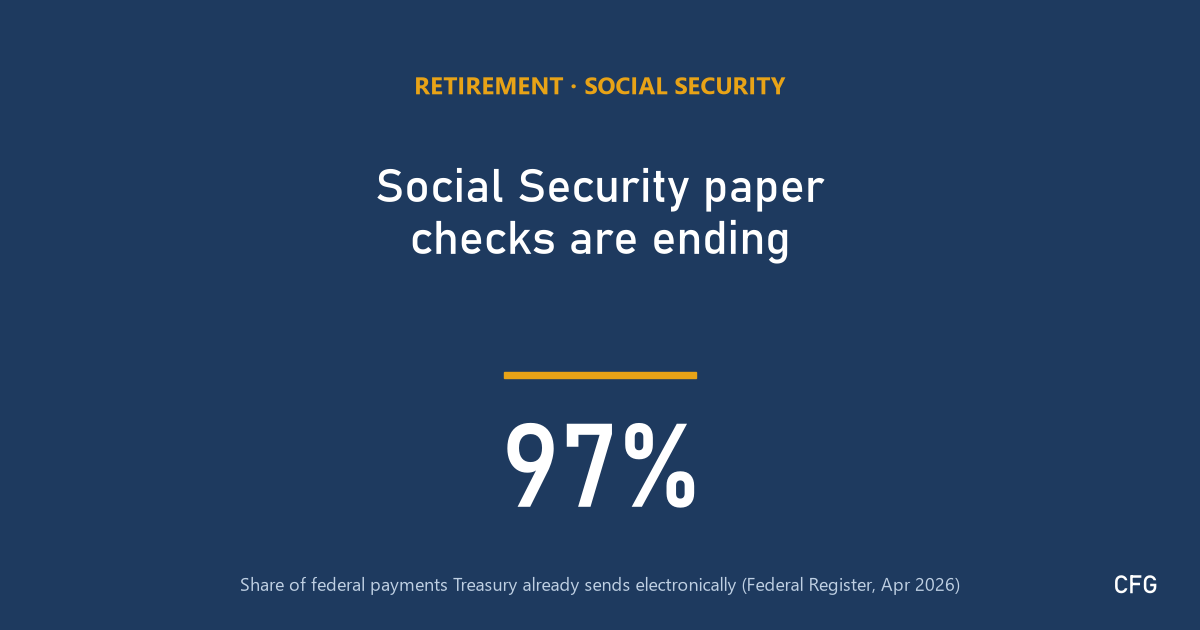
Mostly people who still receive a paper check. Across all federal agencies, Treasury says 97% of its more than 1.3 billion yearly payments already go out electronically. It still printed 40.9 million checks in fiscal 2025, a figure that covers every agency, not just Social Security.
New claimants are affected too, since there’s no paper check fallback while you set up payment. One detail paper-check recipients should know: SSA’s identity page says people paid by paper check must visit a Social Security office before changing their mailing address.
What are your options?
SSA lists three routes:
- Direct deposit through my Social Security. Create or sign in to your account at ssa.gov/myaccount and add your bank information.
- Direct deposit through your bank. Ask your financial institution to send the direct deposit information to SSA electronically.
- Direct Express prepaid debit card. For people without a bank account. Learn more at GoDirect.gov or call 1-800-967-6857, or use the enrollment line in SSA’s letter, 1-800-333-1795, or www.usdirectexpress.com.
SSI recipients and international beneficiaries should call SSA at 1-800-772-1213.
Can you still get a paper check? The Treasury waiver
Possibly, but only through an exception. SSA says the waiver covers people facing challenges such as mental health concerns, or living in a remote location without access to financial institutions.
For now, you request it through the U.S. Treasury, not through SSA.
Treasury’s own EO 14247 FAQ on MyMoney.gov lists the Electronic Payment Solution Center waiver line as 1-855-290-1545. SSA’s September 2025 letter gave 1-877-874-6347 for the same request. We checked Treasury’s page on November 23, 2026; look the number up yourself on a .gov site rather than trusting one from a text or email.
This process may move. In April 2026, Treasury proposed a rule that would have paying agencies such as SSA, rather than Treasury, decide individual hardship waiver requests.
It was a proposal with a comment period that ended June 15, 2026. Check whether it’s been finalized before you apply.
Why is the government doing this?
SSA says paper checks are 16 times more likely to be lost, stolen, altered or returned undeliverable than electronic payments. Treasury puts the average cost to print a check at $3.07, about 20 times the cost of an automated payment.
Here’s that cost gap:
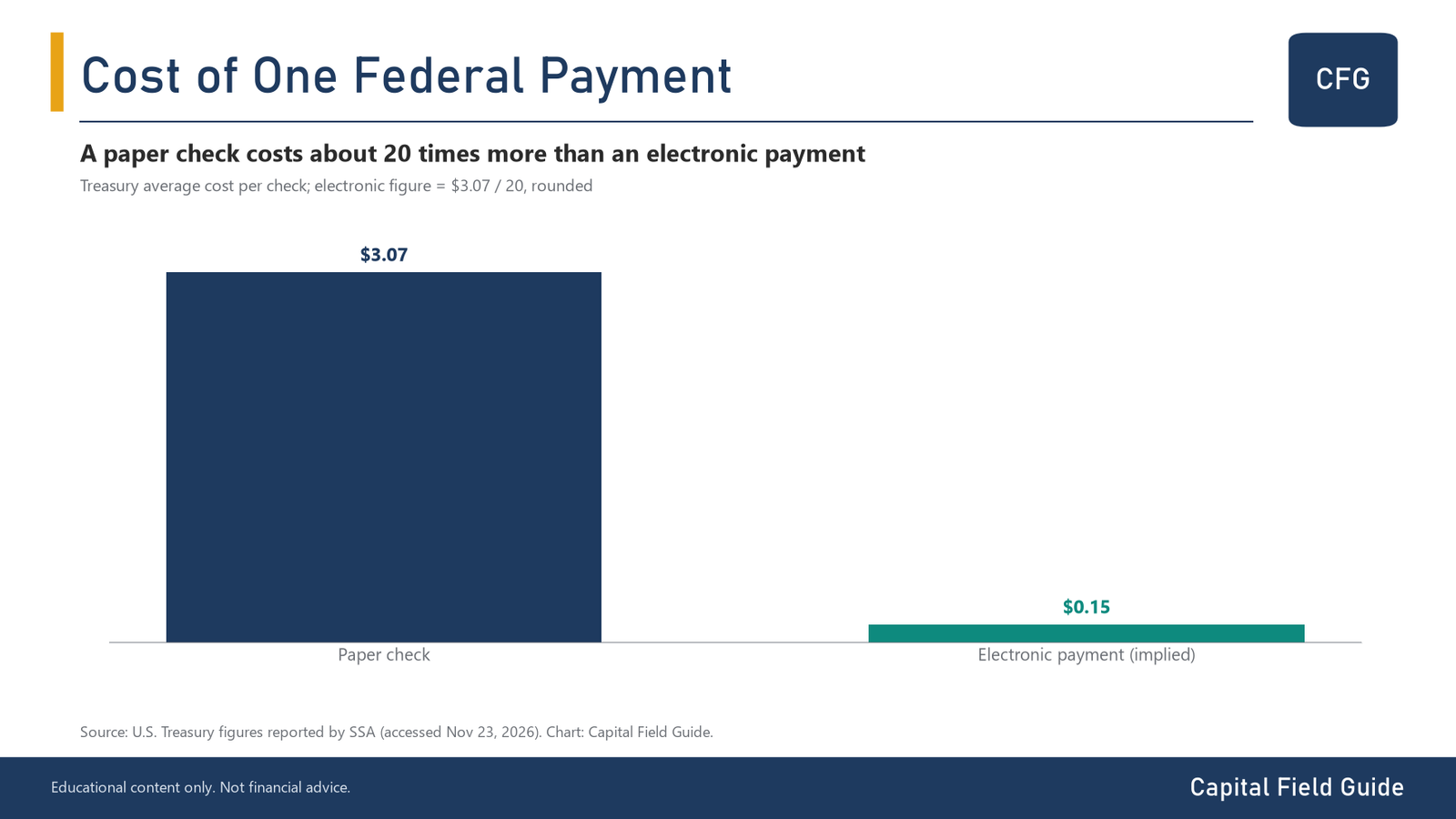
Source: Treasury figures as reported by SSA. The $0.15 electronic cost is our arithmetic ($3.07 / 20), rounded. Chart: Capital Field Guide.

Why did SSA tighten direct deposit changes?
Because your payment is a target. In March 2025, SSA said about 40% of Social Security direct deposit fraud is tied to someone calling SSA to change the bank information.
So SSA added a step. Since April 28, 2025, you can still change direct deposit by phone at 1-800-772-1213, but first you get a one-time code at ssa.gov/PIN, which means signing in to or creating a my Social Security account. Without an account, you’d go to a local office or set up direct deposit through your bank.
Here’s the line from SSA that matters most: people “will continue to receive their benefits on schedule” to the bank account already on file “without needing to prove identity.” The extra step applies when you change the account, not to the deposit you already get.
We read SSA’s identity page and its March 2025 blog post ourselves on November 23, 2026.
What does a real verification look like, and what’s a scam?
A real one starts with something you did: you asked to change your bank info, signed up, or filed a claim. A scam starts with a message you didn’t expect.
Scam red flags
- A call, text or email says your deposit was “flagged” and you must act today.
- Someone asks you to pay with gift cards, prepaid debit cards, wire transfers, cryptocurrency, gold or mailed cash. SSA’s scam page lists all of these as red flags.
- Threats to suspend your Social Security number or seize your bank account, or a push to move money to a “protected” account.
- A text asking you to confirm your identity. SSA says it will never contact you by text to provide or confirm identity information.
- A caller asks for your bank login or a one-time code.
- Caller ID or a link that looks official. SSA warns that scammers spoof government numbers.
If in doubt, hang up and use a number or website you look up yourself, such as ssa.gov or 1-800-772-1213.
What do the viral claims get right and wrong?
Right: paper checks are ending, and changes to direct deposit are more closely checked.
Not supported by the official pages we reviewed: that banks are “flagging” Social Security deposits, or that you must check your account before January or lose payments. SSA’s and Treasury’s pages describe how to switch and how bank changes are verified, not a bank-side flagging program. We can’t prove a negative, so if your bank sends you a notice, call the bank using the number on your card.
Our read: what we’d watch
Our read
If you already have direct deposit, this change probably doesn’t touch you. Your main risk is a scammer using the news to look official.
If you’re still on paper, the deadline feeling is real even though the exact timing isn’t clear from the pages we reviewed. A check that goes missing or arrives late can cost more than a few minutes of setup.
If you can’t go electronic, a waiver exists, but SSA frames it as an exception. If the problem is not having a bank account, Direct Express is the built-in alternative.
The people most likely to get stuck are the ones least likely to read posts like this: no bank account, no internet, no one to help. If a parent or neighbor still gets a paper check, helping them switch before a payment goes missing may matter more than anything else here.
If Treasury finalizes its April 2026 proposal, waiver requests would go to SSA instead of Treasury, and the proposal says it would eliminate or modify some waivers individuals can use today. That would make it harder, not easier, to stay on paper.
Here’s what we’d watch: a final rule in the Federal Register and SSA’s own news page, not social posts.
What can you do today?
A short checklist for today
1. Sign in to my Social Security. Some beneficiaries create or check their account at ssa.gov/myaccount. Make sure the web address is exactly that.
2. Confirm your bank information. Many people compare the routing and account numbers on file with a recent bank statement.
3. Turning on bank alerts. Some people set deposit alerts with their bank so a missing or redirected payment shows up fast.
4. Know the official numbers. Some keep SSA’s 1-800-772-1213 and the Direct Express line 1-800-333-1795 written down, and avoid numbers from texts or pop-ups.
FAQ
Will my Social Security payment amount change?
No. The official pages describe a change in payment method, not in benefit amount.
Does a verification step mean my payment is on hold?
SSA says people keep getting benefits on schedule to the account already on file without proving identity again. The extra checks apply when someone tries to change the account.
The bottom line
Paper checks are on their way out, and the official fix is simple: direct deposit, or Direct Express if you don’t bank.
Sign in to my Social Security, check your bank details, and keep the real phone numbers handy.
A real change asks you to act through channels you chose. A scam asks you to act through the one it chose.
Further reading: Social Security’s 3.6% Raise for 2027: What Actually Lands in Your Bank Account
Sources
– Social Security Administration, Social Security To Fully Transition To Electronic Payments
– Social Security Administration, Dear Colleague letter: Social Security Transitions to Electronic Payments, Sept 10, 2025
– Social Security Administration, What to Know about Proving Your Identity (updated Apr 28, 2025)
– Social Security Administration blog, Correcting the Record About Social Security Direct Deposit and Telephone Services, Mar 12, 2025
– SSA and SSA OIG, Protect Yourself from Scams
– Federal Register, Executive Order 14247, Modernizing Payments To and From America’s Bank Account (Mar 28, 2025)
– Bureau of the Fiscal Service, Management of Federal Agency Disbursements, proposed rule, Apr 29, 2026
– U.S. Treasury, Frequently Asked Questions on EO 14247 (MyMoney.gov, waiver line)
– Treasury, GoDirect.gov (switching to electronic payment)
All pages accessed November 23, 2026.
Rules and numbers can change. Check SSA.gov and Treasury before acting.
Disclaimer: This content is for general information and education only. It is not a recommendation to buy or sell any security, and it does not consider your personal financial situation. Investing involves risk, including possible loss of principal. You are responsible for your own investment decisions. Capital Field Guide and its authors are not liable for any losses or damages arising from the use of this information. Consider consulting a licensed financial, tax, or legal professional before acting.