This article is for educational purposes only and is not legal, tax, or financial advice. Medicaid rules vary by state. Read our Disclaimer.
Last reviewed: November 10, 2026. Sources are listed at the end.
You spent thirty years paying off the house. Now someone online says Medicaid will take it.
That fear is common, and it’s partly right. But the scariest version of the story, where the state shows up and evicts you the day you need care, isn’t how the rules work.
The real risk is quieter. It shows up after you die, and it can be planned for.
Key takeaway
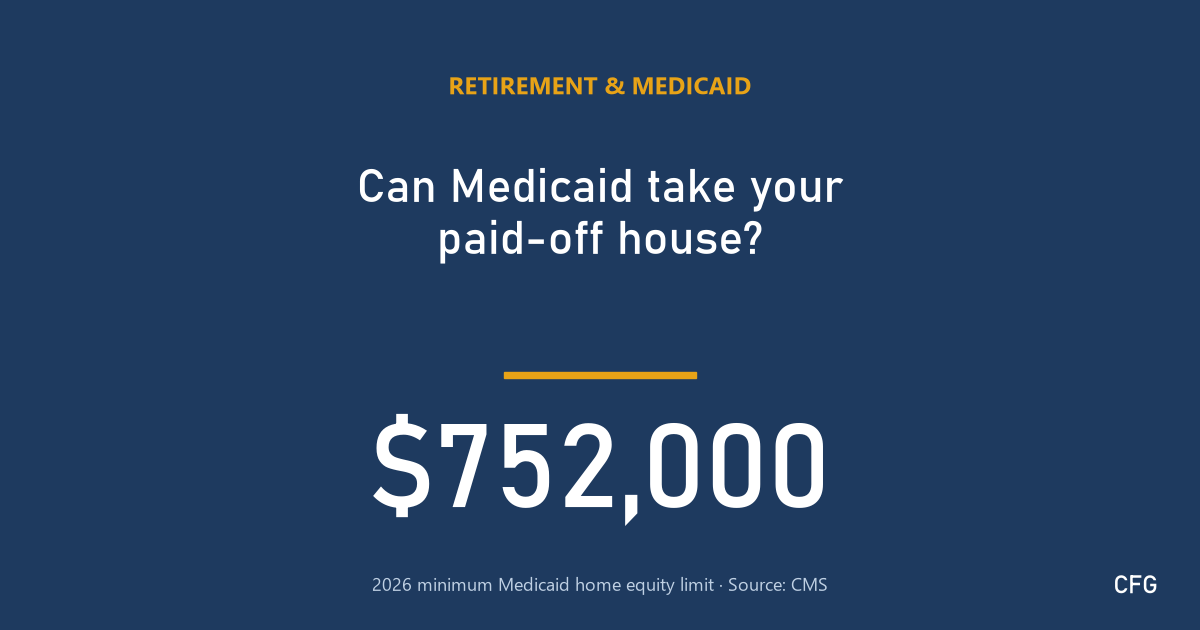
While you’re alive, your home is usually an exempt asset for Medicaid long-term care if your equity is under your state’s limit ($752,000 to $1,130,000 in 2026). After you die, though, your state must try to recover what it spent on your long-term care if you were 55 or older, and the house is often the biggest thing left. A surviving spouse or a young or disabled child delays or blocks that recovery.
Key numbers
| Item | Figure |
|---|---|
| Home equity limit, 2026 (states choose within range) | $752,000 to $1,130,000 |
| Federal cap on that limit, starting Jan 1, 2028 (homes not on land zoned for agriculture) | $1,000,000 |
| Look-back period for gifts and below-value transfers | 60 months |
| Age at which estate recovery becomes mandatory | 55 and older |
| Median nursing home cost, private room (2025) | $129,575 a year (about $355 a day) |
| Median nursing home cost, semi-private room (2025) | $114,975 a year |
| Nursing home residents with Medicaid as primary payer | More than 6 in 10 |
Sources: CMS Informational Bulletin (Dec 9, 2025); Public Law 119-21, sec. 71108; Social Security Act sec. 1917; CareScout 2025 Cost of Care Survey; KFF.

Why so many people end up on Medicaid
Medicare doesn’t pay for long-term custodial care. It covers a limited skilled nursing stay after a qualifying hospital stay, up to 100 days per benefit period, and not the months or years of help with bathing, dressing and eating that many people eventually need.
That care is expensive. At a median of about $129,575 a year for a private room, a three-year stay costs close to $390,000.
That’s why Medicaid, the program built for people with few assets, ends up paying for most nursing home residents. People spend down their savings, then qualify.
The house is where the rules get special treatment.
While you’re alive: the home is usually protected
To qualify for Medicaid long-term care, most of your countable assets have to be spent down to a very low level. Your home generally isn’t counted, as long as:
- your equity (value minus mortgage) is under your state’s limit, and
- you live there, your spouse or a dependent relative lives there, or you intend to return, depending on your state’s rules.
The equity limit doesn’t apply at all if your spouse, a child under 21, or a blind or disabled child lives in the home.
Here’s how those limits have moved:
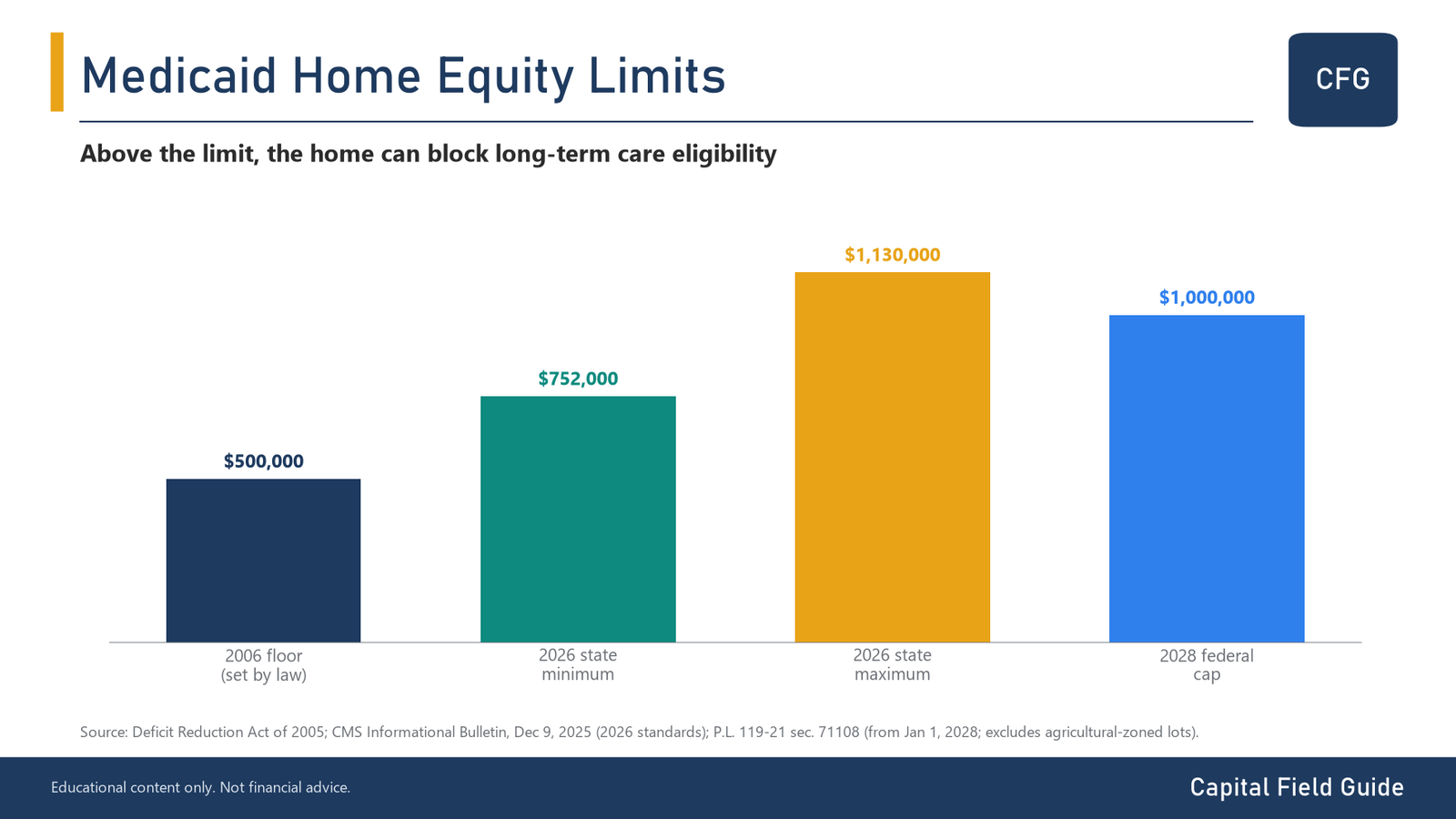
The limits rise every year with inflation. That changes in 2028.
Under section 71108 of the 2025 budget law (Public Law 119-21), the limit is capped at $1 million, with no inflation increases above that, unless the home sits on a lot zoned for agricultural use. States that use the top of the range will have to come down to $1 million. States at the minimum aren’t affected right away, but their limit will eventually run into the cap as it rises with inflation.
Many states use the $752,000 minimum, which is a lot of house for most retirees. The states that use the higher limit, such as New York and Massachusetts, are the ones whose limit drops to $1 million in 2028. In their priciest areas, a paid-off home can top even that.
The part that surprises families: estate recovery
This is the real answer to “Can Medicaid take my house?”
Federal law requires every state to seek repayment from the estates of people who received Medicaid at 55 or older, for nursing facility care, home and community-based services, and related hospital and drug costs. Once you’ve died, the house you couldn’t be forced to sell is often the main asset in your estate.
Here’s the full sequence:
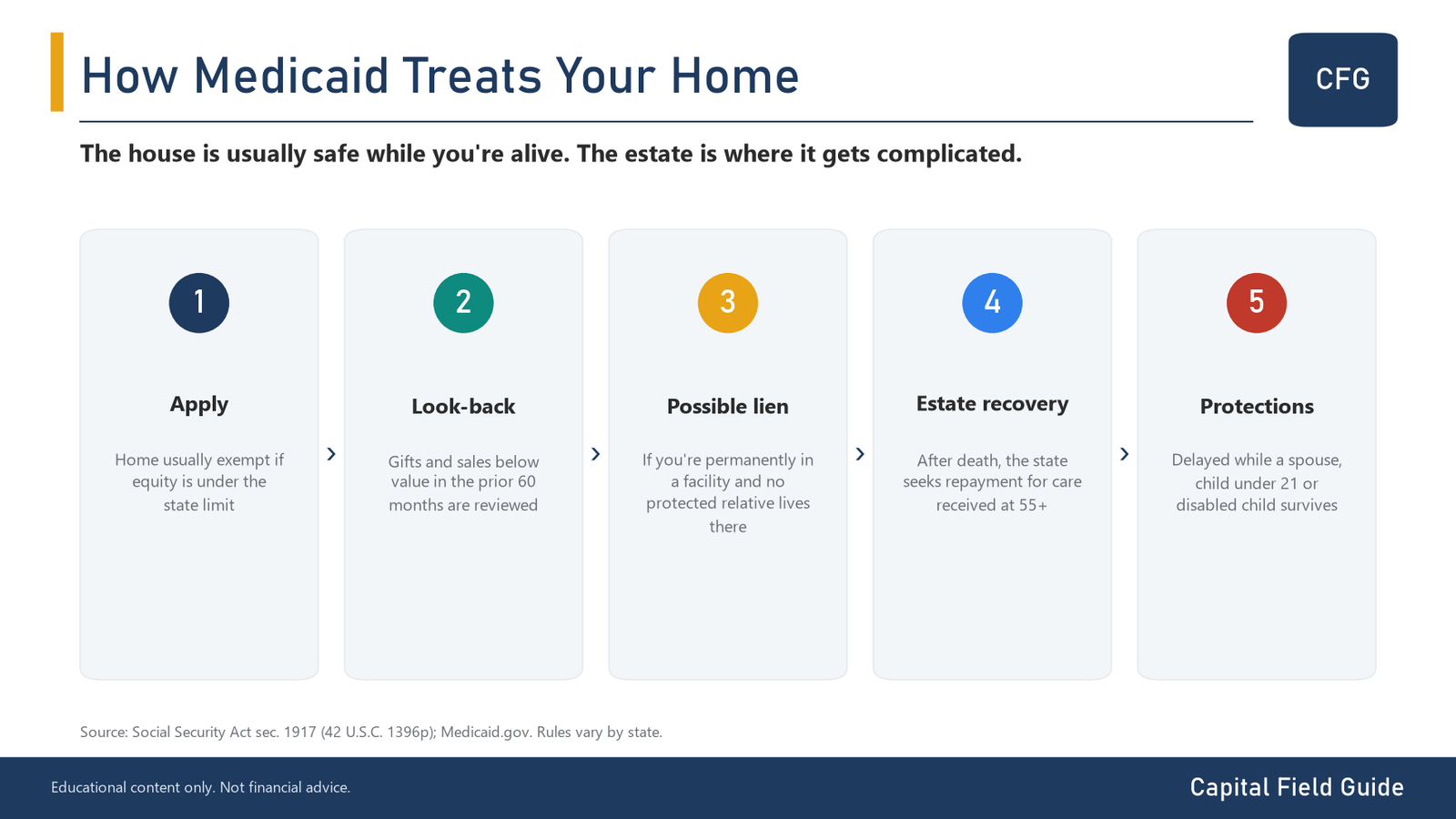
Three protections matter most:
- Spouse first. Recovery can only happen after a surviving spouse has also died.
- Children. No recovery while there’s a surviving child under 21, or a blind or disabled child of any age.
- Hardship. Every state must have a process to waive recovery when it would cause undue hardship.
States differ a lot beyond that. Some recover only from the probate estate. Others reach assets that pass outside probate, such as jointly owned property.
Some states also place a lien on the home while a person is permanently in a facility. They can’t when a spouse, a child under 21, a blind or disabled child, or certain co-owning siblings live there.

The mistake that backfires: giving the house to the kids
The instinct makes sense. If you don’t own it, Medicaid can’t count it.
But Medicaid looks back 60 months. Give the house away within five years of applying and you can face a penalty period, months when Medicaid won’t pay for your care even though you’ve run out of money.
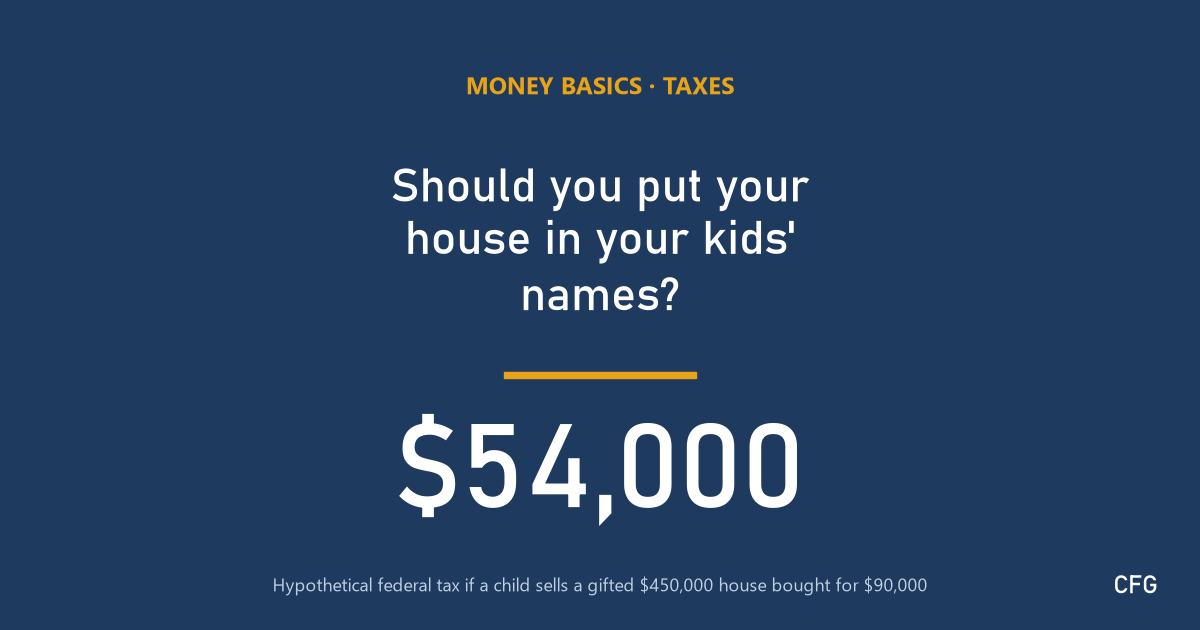
There’s also a tax cost. Children who inherit a home generally get a “stepped-up” cost basis, so the gain built up during your lifetime isn’t taxed when they sell.
Children who receive it as a gift usually take over your original basis. On a house bought for $150,000 and now worth $500,000, that difference can mean tax on up to $350,000 of gain.
The law does allow some transfers without penalty: to a spouse, to a child under 21 or a blind or disabled child, to a sibling with an ownership stake who lived there at least a year beforehand, or to an adult child who lived there for two years and provided care that kept the parent out of a facility.
History check: how we got here
These rules were built in layers.
In 1982, Congress allowed states to place liens on the homes of people permanently in nursing facilities. In 1993, it made estate recovery mandatory. The Deficit Reduction Act of 2005 added the home equity limit, starting at $500,000, and stretched the look-back from 36 months to 60.
Each of those laws narrowed the room for people with assets to qualify while keeping their home. The 2028 cap is the latest step in that direction.
Our read: what we’d watch
Our read
This is our opinion, not a prediction you should bet on.
If state Medicaid budgets come under more pressure from the 2025 federal changes, some states may look harder at estate recovery, since it brings in money without cutting benefits. The counterpoint is real: recoveries are a tiny slice of long-term care spending, and Medicaid’s own advisory commission (MACPAC) has recommended making estate recovery optional rather than mandatory. So we’d watch state budgets, not just federal law.
If budgets stay steady, the rules may barely change for most families outside the high-cost states hit by the $1 million cap.
Either way, the families who lose the most are usually not the ones with big estates. They’re the ones who acted in a hurry, gifting a house within the look-back window or never checking how their state defines an estate.
What you can do this month
Practical steps
1. Look up your state’s estate recovery rules. Your state Medicaid agency publishes them. Note whether it recovers only from probate assets or more broadly, and what its home equity limit is.
2. Know how your home is titled. Sole ownership, joint ownership and trust ownership can be treated very differently in your state.
3. Think twice before deeding the house away on your own. Some families in this situation meet with an elder law attorney before moving anything, because the look-back and the loss of stepped-up basis can cost more than the problem they were trying to solve.
4. Price out the alternatives. Some people consider long-term care insurance or hybrid life policies while they’re still healthy enough to qualify. Others set aside savings for a few years of private-pay care. Each has trade-offs in cost and coverage.
Good to know
CMS publishes new home equity limits each year, usually late in the year, effective January 1. The 2027 figures hadn’t been posted when we checked on November 10, 2026.
FAQ
Can Medicaid take my house while I’m still living in it?
Generally, no. If your equity is under your state’s limit and you or a protected family member live there, the home is usually exempt. A lien may be possible if you’re permanently in a facility, depending on your state.
What happens to the house if my spouse still lives there?
Estate recovery is delayed until after the surviving spouse dies. The home equity limit also doesn’t apply while your spouse lives there.
Does the $1 million cap apply now?
No. It starts January 1, 2028, and doesn’t apply to a home on a lot zoned for agricultural use.
Is estate recovery the same in every state?
No. The federal rules set a minimum. States choose how broadly to define the estate and how hardship waivers work.
The bottom line
Medicaid rarely takes a house from a living person. After death, though, estate recovery can claim part or all of its value if no protected family member survives.
The difference between those two outcomes is usually planning done early and calmly. Paying off the house was the hard part. Protecting it starts with knowing your state’s rules.
Further reading: Social Security’s 3.6% Raise for 2027: What Actually Lands in Your Bank Account
Sources
– CMS, Informational Bulletin: 2026 SSI, Spousal Impoverishment, and Medicare Savings Program Resource Standards (Dec 9, 2025; accessed Nov 10, 2026)
– Medicaid.gov, Estate Recovery and Spousal Impoverishment
– Social Security Act sec. 1917, 42 U.S.C. 1396p (liens, transfers, estate recovery, home equity)
– Public Law 119-21 (2025), sec. 71108, enrolled text on GovInfo; summary by Justice in Aging
– CareScout, 2025 Cost of Care Survey (released Mar 2, 2026)
– KFF, 5 Key Facts About Nursing Facilities and Medicaid
– MACPAC, Medicaid Estate Recovery: Improving Policy and Promoting Equity (March 2021)
– Medicare.gov, Skilled nursing facility care
Rules vary by state and can change. Check your state Medicaid agency before acting.
Disclaimer: This content is for general information and education only. It is not a recommendation to buy or sell any security, and it does not consider your personal financial situation. Investing involves risk, including possible loss of principal. You are responsible for your own financial decisions. Capital Field Guide and its authors are not liable for any losses or damages arising from the use of this information. Consider consulting a licensed financial, tax, or legal professional before acting.