This article is for educational purposes only and is not investment, tax, or legal advice. Read our Disclaimer.
Last reviewed: November 20, 2026. Sources are listed at the end.
You want your kids to end up with the house, and you’d like to skip probate and keep things simple. Putting their names on the deed sounds like the easy fix. It can also cost them tens of thousands of dollars in tax.
This post shows the math, then covers the gift tax form, the Medicaid look-back and the alternatives.
We read the IRS rules and federal statutes on November 20, 2026. Treat this as a map for a conversation with a lawyer.
Key takeaway
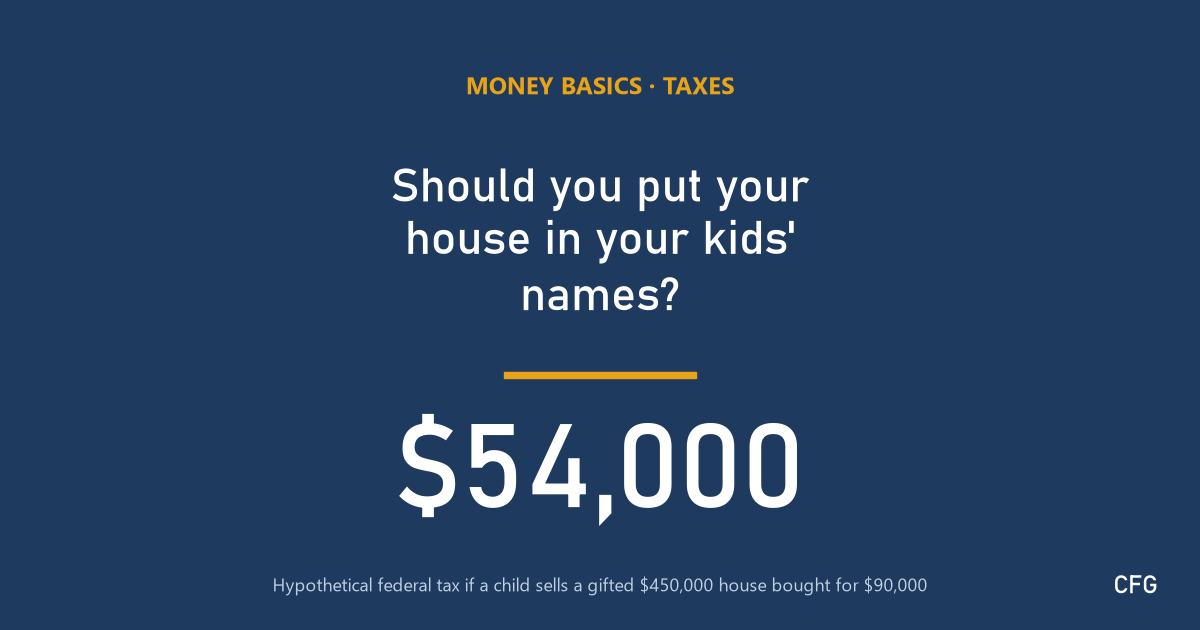
A gifted house keeps your original cost basis. An inherited house gets a basis equal to its value on the date you die. In our hypothetical, a house bought for $90,000 and worth $450,000 leaves a child with about $54,000 in federal tax at a flat 15% rate if they sell after a gift, and about $0 if they sell right after inheriting. A gift also means a Form 709, and it falls inside Medicaid’s 60-month look-back if long-term care is needed within five years.
Key numbers
| Item | Figure | Source date |
|---|---|---|
| Gift / inheritance: recipient’s basis | Donor’s basis (§1015) / value at death (§1014) | Nov 20, 2026 |
| Home sale exclusion (IRC §121) | $250,000 single / $500,000 joint | Nov 20, 2026 |
| 2026 annual gift exclusion / 2027 | $19,000 / $20,000 per recipient | IRS, Nov 2026 |
| Lifetime estate and gift exemption 2026 / 2027 | $15,000,000 / $15,480,000 | IRS, Nov 2026 |
| 2027 long-term gains: 0% up to / 15% up to (single) | $51,050 / $563,200 | Rev. Proc. 2026-35 |
| Medicaid look-back for transfers | 60 months | 42 U.S.C. §1396p |
Sources: Cornell LII (26 U.S.C. 1014, 1015, 121; 42 U.S.C. 1396p); IRS Newsroom IR-2026-133; IRS Rev. Proc. 2026-35 (accessed Nov 20, 2026).

Why does a gifted house cost more in tax than an inherited one?
Two tax rules do the work. If you give property away, IRC §1015 says the recipient generally takes your basis, meaning your original cost. If someone inherits it, IRC §1014 generally sets their basis at fair market value on the date of death.
Here’s a hypothetical with round numbers. Say you bought your house decades ago for $90,000, and it’s worth $450,000 today. We’re ignoring improvements and selling costs.
| Gift now | Inherit at death | |
|---|---|---|
| Child’s basis | $90,000 | about $450,000 |
| Sale price | $450,000 | $450,000 |
| Taxable gain | $360,000 | about $0 |
| Federal tax at 15% | $54,000 | about $0 |
The math is $450,000 minus $90,000 is $360,000, and 15% of that is $54,000. We used a flat 15% to keep it simple. Part of a gain may fall in the 0% bracket, and a big one can reach 20%: for 2027, the 15% rate runs up to $563,200 of taxable income for single filers and $633,600 for joint filers (Rev. Proc. 2026-35). The 3.8% net investment income tax can apply above $200,000 single or $250,000 joint modified adjusted gross income, and state tax varies.
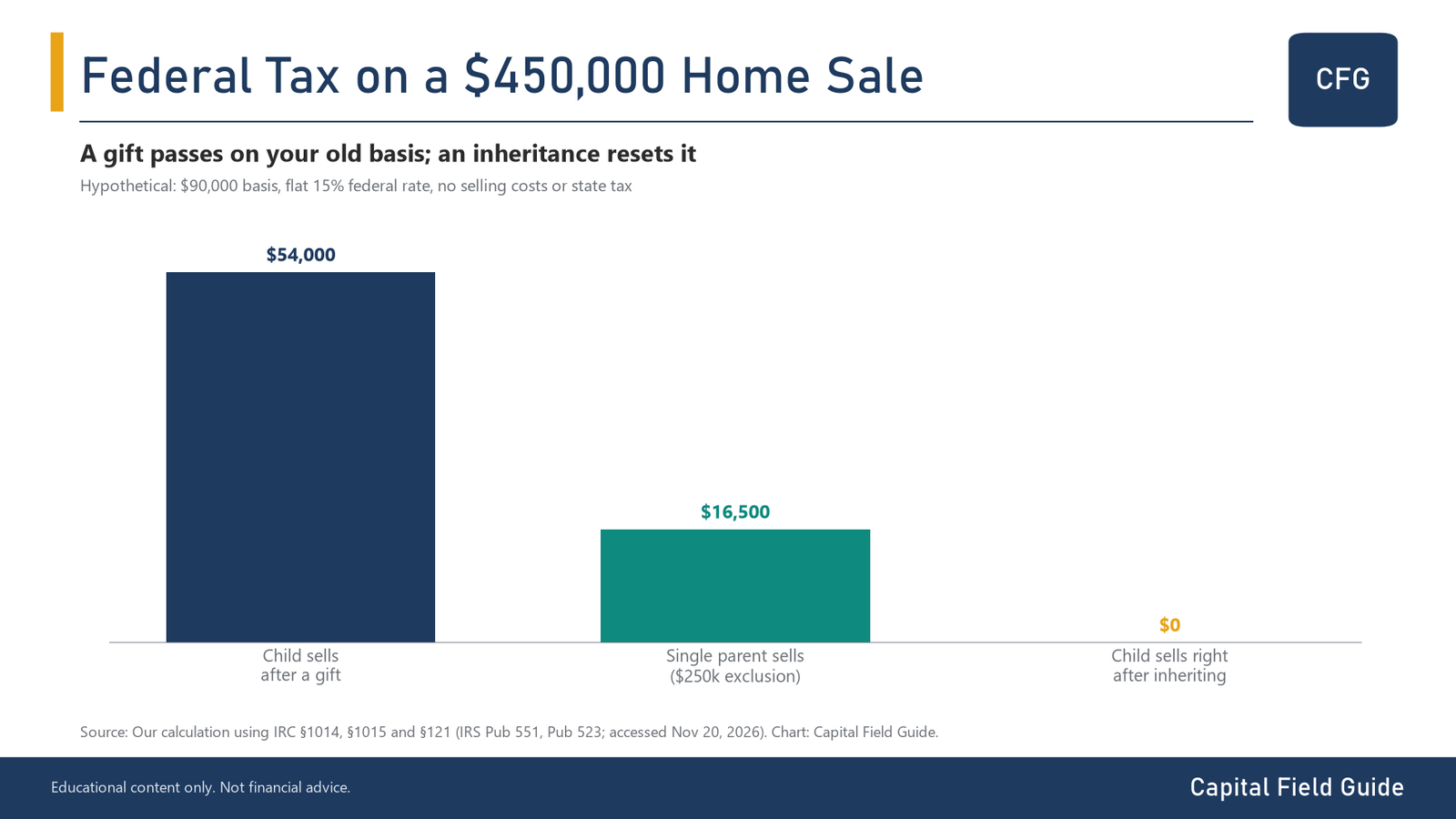
Source: Our calculation from IRS rules. Hypothetical: $90,000 basis, flat 15%. Chart: Capital Field Guide.
What happens to your own home sale exclusion?
If you own and live in the home for two of the five years before a sale, IRS Publication 523 lets you exclude up to $250,000 of gain, or $500,000 on a joint return (generally both spouses must meet the two-year use test). Once you give the house away, that exclusion is no longer yours to use on it.
Your child can claim it only if the house becomes their own main home for the required time. In this example, a child who lived there two of five years could exclude $250,000, cutting the tax to $16,500.
In the same example, a single parent who sold at $450,000 would have $360,000 of gain, less the $250,000 exclusion, leaving $110,000 taxable. At 15%, that’s $16,500. A married couple filing jointly who both met the use test would owe no federal tax.

Do you have to file a gift tax return?
Often yes, but you probably won’t owe anything. For 2026, the annual exclusion is $19,000 per recipient. A house worth $450,000 is far above that, so a Form 709 is due by April 15 of the following year. The IRS says you file “whether or not any tax is ultimately due.”
In our example, $450,000 minus $19,000 is a $431,000 taxable gift. It uses part of the lifetime exemption, $15,000,000 for 2026 and $15,480,000 for 2027, so no gift tax is owed. The annual exclusion rises to $20,000 in 2027 (IRS, November 5, 2026). Adding a child to the deed can also count as a gift of a share of the home, which an attorney or tax pro can value. Only the gifted share carries your old basis; the share you still own at death can generally get the date-of-death basis.
What about Medicaid?
Federal law (42 U.S.C. §1396p) sets a 60-month look-back for long-term care Medicaid. If you give assets away for less than fair market value in that window, you can be denied nursing-home coverage for a penalty period. The length is the value you gave away divided by your state’s average monthly private nursing-home cost.
The look-back works backward from the date you apply. A gift made more than 60 months before an application generally isn’t penalized, which is why some families plan years ahead and accept the basis cost.
Federal law lists exceptions for a home transferred to a spouse, a child under 21, a blind or disabled child, a sibling with an equity interest who lived there at least a year, or a child who lived there at least two years and, as determined by the state, provided care that let you stay home. Details vary by state, so an elder law attorney or your state Medicaid agency is the place to confirm.
What other risks come with a shared deed?
Once a child is on the title, the house is partly theirs. Depending on state law, a co-owner’s creditors, a lawsuit or a divorce may reach that share, and you may need their signature to sell or refinance. A 2026 National Consumer Law Center brief puts adding a co-owner to the deed “among the riskiest estate planning options.”
Some states also change property tax exemptions after a transfer; your county assessor can say how yours works.
What do families ask an estate attorney about instead?
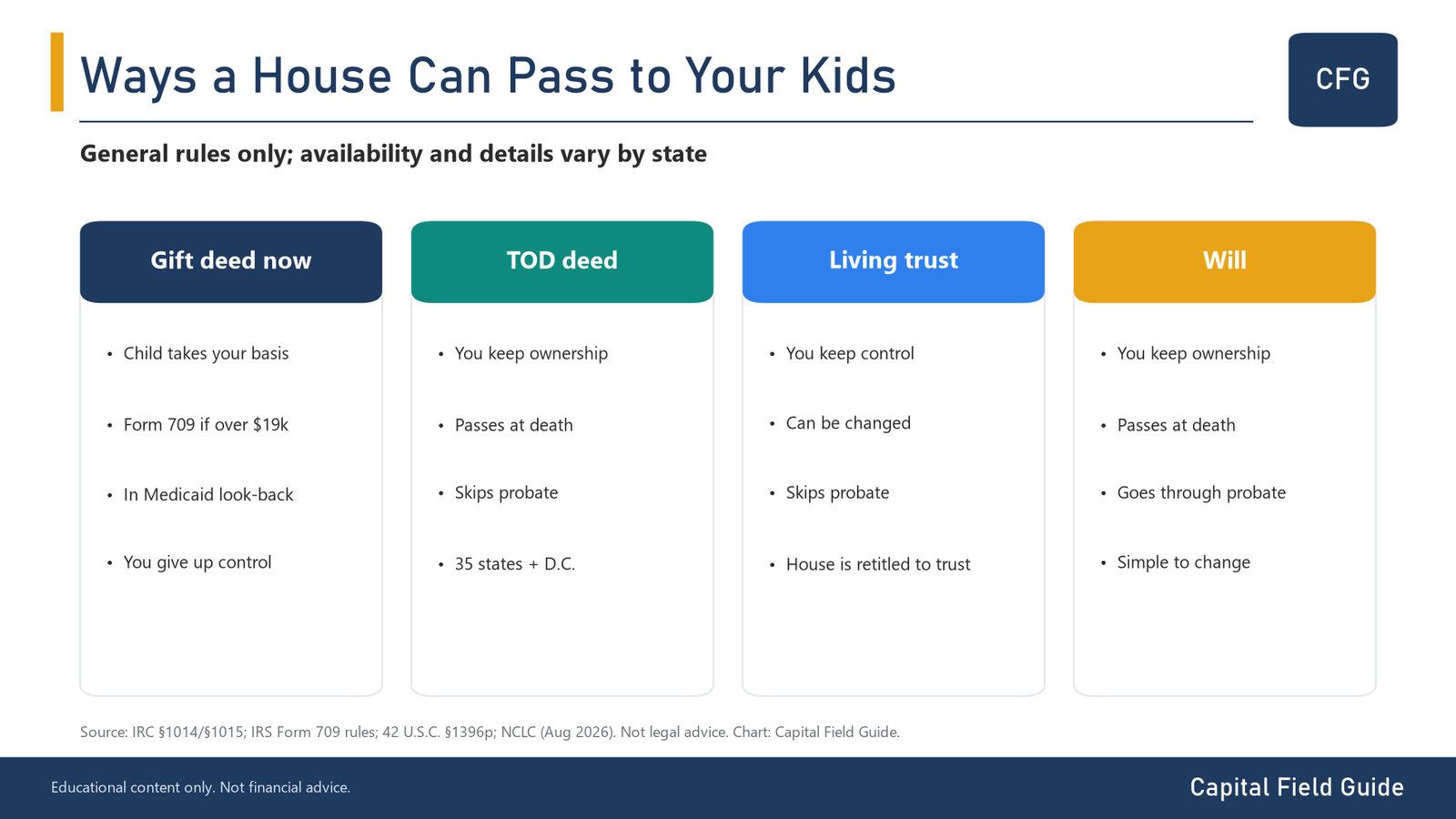
Source: Our summary of general rules; availability and details vary by state. Chart: Capital Field Guide.
- Transfer-on-death (TOD) deed. You keep ownership while alive, and the home passes at death outside probate. The NCLC counted 35 states plus D.C. with TOD deed laws in 2026, but not every state has one.
- Revocable living trust. You keep control and can change it. It can avoid probate, and it’s generally treated as still yours for tax purposes.
- Life estate deed. You keep the right to live there for life, and your kids get the remainder now. That remainder can count as a gift for Form 709 and the Medicaid look-back, and a later sale needs their signatures.
- A will. Simple, but the house generally goes through probate.
With these tools the house generally stays in your estate at death, so the date-of-death basis can apply. One limit: skipping probate generally doesn’t shield the home from Medicaid estate recovery in states that pursue non-probate assets, and some states restrict TOD deeds for Medicaid recipients.
Our read: what we’d watch
Our read
This is our opinion, not legal or tax advice.
If the house has risen a lot in value, the basis gap is usually the biggest tax issue. A lifetime gift can turn into a large, avoidable gain for your child.
If long-term care is a real possibility, the Medicaid look-back can matter more than the tax. A transfer within 60 months of applying can trigger a penalty period; planning done well before that window is a different calculation.
If the home has barely gone up in value, or nobody plans to sell, the basis cost may be small. Families near the $15 million federal exemption, or in states with their own estate tax, face a different trade-off.
If the main goal is skipping probate, a TOD deed or a trust is what many people ask about first, because you keep ownership and the date-of-death basis can still apply.
Here’s what we’d watch: your state’s TOD deed law, your Medicaid rules, and how much the home has appreciated.
What some families do first
Practical steps
1. Knowing the basis. Some families find the purchase price and improvements, then compare them with today’s value.
2. A state-specific legal review. Many families take the basis, Medicaid and deed questions above to an estate attorney in their state.
3. The 60-month window. Some families weigh the look-back against their age and health before moving anything.
FAQ
Is there gift tax when I give my child my house?
Usually no tax is due, but a Form 709 is generally required if the gift is over the annual exclusion ($19,000 in 2026). The value reduces your lifetime exemption.
Can I avoid probate without giving the house away now?
In many states, yes. A transfer-on-death deed or a revocable living trust can pass the home outside probate while you keep ownership. Availability and rules vary by state.
The bottom line
Putting your kids on the deed may feel like a simple favor, but a gifted house carries your old cost basis, can cost you a home sale exclusion, may need a Form 709 and counts in Medicaid’s look-back.
An estate attorney in your state can show how a TOD deed, a trust or a will would handle your house before anything is signed.
Next: Can Medicaid Take Your Paid-Off House? What the Rules Actually Say
Further reading: 2027 Tax Brackets and Standard Deduction
Sources
– Cornell LII, 26 U.S.C. §1015, Basis of property acquired by gifts, §1014, Basis of property acquired from a decedent and §121, Exclusion of gain from sale of principal residence
– IRS, Publication 551, Basis of Assets and Publication 523, Selling Your Home
– IRS, Instructions for Form 709 (2025 edition) and Frequently asked questions on gift taxes
– IRS, Newsroom IR-2026-133, 2027 inflation adjustments, Rev. Proc. 2026-35 and Rev. Proc. 2025-32
– IRS, Topic no. 559, Net investment income tax
– Cornell LII, 42 U.S.C. §1396p, Liens, adjustments and recoveries, and transfers of assets
– National Consumer Law Center, Protecting the Family Home: TODDs (Aug 2026)
– Elder Law Answers, Giving your home to your children can have tax consequences (Oct 16, 2026)
Rules and amounts can change. Check the sources before acting.
Disclaimer: This content is for general information and education only. It is not tax, legal or investment advice, and it does not consider your personal situation. State laws on deeds, Medicaid and property tax vary. You are responsible for your own decisions. Capital Field Guide and its authors are not liable for any losses or damages arising from the use of this information. Talk to an estate attorney in your state and consider consulting a licensed tax professional before acting.